
Ctrl K
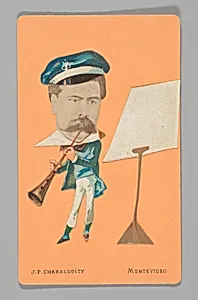
1848–1909
Juan Pedro Chabalgoity (1848–1909) stands as one of the pioneering figures of Uruguayan academic painting, a generation that sought to establish a national artistic tradition while remaining deeply connected to European models. Born in Uruguay, he pursued formal training abroad, traveling to Europe to refine his craft in the manner of the academies then dominant on the continent. His formation placed him squarely within the realist and academic traditions that shaped Latin American art throughout the second half of the nineteenth century.
Chabalgoity's work is characterized by careful attention to naturalistic rendering, balanced composition, and a preference for subjects drawn from everyday Uruguayan life, portraiture, and landscape. He was among the first artists to bring a technically disciplined European academic approach to the depiction of the River Plate region, helping to define what a distinctly Uruguayan painting might look like during a formative period of national cultural identity.
His portraits in particular distinguished him among his contemporaries, combining psychological attentiveness with the polished finish expected of academic practice. He contributed to the cultural life of Montevideo at a time when institutions supporting the visual arts were still nascent, making his role not merely artistic but also pedagogical and civic.
Chabalgoity's legacy resides in his contribution to the foundation of a professional artistic culture in Uruguay. As one of the earliest academically trained Uruguayan painters to work consistently in his home country, he helped prepare the ground for subsequent generations who would go on to build the rich tradition of Uruguayan modernism in the twentieth century.
![[Photo Collage: Musician Playing Trombone]](https://images.artheonmuseum.org/met/ph/thumb/photo-collage-musician-playing-trombone-764766.webp)
![[Photo Collage: Musician with Large Brass Horn, Uruguay]](https://images.artheonmuseum.org/met/ph/thumb/photo-collage-musician-with-large-brass-horn-uruguay-745550.webp)
![[Photo Collage: Man Wearing Blue Top Hat]](https://images.artheonmuseum.org/met/ph/thumb/photo-collage-man-wearing-blue-top-hat-764771.webp)
![[Photo Collage: Three People Holding Oars, Sitting on a Large Fish]](https://images.artheonmuseum.org/met/ph/thumb/photo-collage-three-people-holding-oars-sitting-on-a-large-fish-764792.webp)
![[Photo Collage: Man with Prosthetic Leg]](https://images.artheonmuseum.org/met/ph/thumb/photo-collage-man-with-prosthetic-leg-764777.webp)
![[Photo Collage: Woman Holding "1880" Calendar for March and April]](https://images.artheonmuseum.org/met/ph/thumb/photo-collage-woman-holding-1880-calendar-for-march-and-april-764783.webp)
![[Photo Collage: Man Pushing Woman in Wheelbarrow]](https://images.artheonmuseum.org/met/ph/thumb/photo-collage-man-pushing-woman-in-wheelbarrow-764785.webp)
![[Photo Collage: Man with Broom and Dustpan]](https://images.artheonmuseum.org/met/ph/thumb/photo-collage-man-with-broom-and-dustpan-764781.webp)
![[Photo Collage: Man Holding Parcel]](https://images.artheonmuseum.org/met/ph/thumb/photo-collage-man-holding-parcel-764770.webp)
![[Photo Collage: Man Sitting at Cocktail Table]](https://images.artheonmuseum.org/met/ph/thumb/photo-collage-man-sitting-at-cocktail-table-764776.webp)
![[Photo Collage: Woman on Ladder, Holding Spyglass with Man Holding Ladder, and Dog Standing on Hind Legs]](https://images.artheonmuseum.org/met/ph/thumb/photo-collage-woman-on-ladder-holding-spyglass-with-man-holding-ladder-and-dog-s-764782.webp)
![[Photo Collage: Two Men with Mop and Water Bucket]](https://images.artheonmuseum.org/met/ph/thumb/photo-collage-two-men-with-mop-and-water-bucket-764788.webp)
![[Photo Collage: Girl with Doll]](https://images.artheonmuseum.org/met/ph/thumb/photo-collage-girl-with-doll-764779.webp)
![[Photo Collage: Man Drawing Bust]](https://images.artheonmuseum.org/met/ph/thumb/photo-collage-man-drawing-bust-764772.webp)
![[Photo Collage: Woman Holding Bird]](https://images.artheonmuseum.org/met/ph/thumb/photo-collage-woman-holding-bird-764774.webp)
![[Photo Collage: Cook at Charcoal Stove]](https://images.artheonmuseum.org/met/ph/thumb/photo-collage-cook-at-charcoal-stove-764780.webp)
![[Photo Collage: Man Holding Bag Inscribed "DOTE"]](https://images.artheonmuseum.org/met/ph/thumb/photo-collage-man-holding-bag-inscribed-dote-764773.webp)
![[Photo Collage: Man Playing Cymbals]](https://images.artheonmuseum.org/met/ph/thumb/photo-collage-man-playing-cymbals-764775.webp)
![[Photo Collage: Man Reclining with Violin]](https://images.artheonmuseum.org/met/ph/thumb/photo-collage-man-reclining-with-violin-764790.webp)
![[Photo Collage: Man in Long Red Coat]](https://images.artheonmuseum.org/met/ph/thumb/photo-collage-man-in-long-red-coat-764778.webp)
![[Photo Collage: Musician Playing Triangle]](https://images.artheonmuseum.org/met/ph/thumb/photo-collage-musician-playing-triangle-764764.webp)
![[Photo Collage: Musician Playing Trumpet]](https://images.artheonmuseum.org/met/ph/thumb/photo-collage-musician-playing-trumpet-764763.webp)
![[Photo Collage: Two People Holding Girl in Water]](https://images.artheonmuseum.org/met/ph/thumb/photo-collage-two-people-holding-girl-in-water-764787.webp)