
Ctrl K
1827–1906
Jujoen (1827–1906), also known by the signature Issen, was a Japanese poet and painter active during the late Edo and early Meiji periods. Little is known about his early life, which remains not well documented, though he emerged as a versatile artist blending poetry and visual art in the tradition of surimono—deluxe, privately commissioned woodblock prints often produced for poetic circles or New Year's celebrations. These works typically featured embossing, mica, and vibrant colors, reflecting the refined tastes of literati patrons amid Japan's shifting cultural landscape.
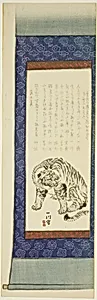
Jujoen's most celebrated surviving work is *Tiger* (1866), a striking color woodblock surimono created as a New Year's print for the Year of the Tiger in the zodiac cycle. Measuring approximately 11.5 x 36.8 cm, it ingeniously mimics a traditional hanging scroll complete with simulated silk mounting, showcasing a fierce yet elegant tiger prowling through misty bamboo. Jujoen not only designed the image but also composed one of the accompanying poems, signed and sealed as "Issen." This fusion of painting, poetry, and printmaking highlights his mastery of form and his playful innovation, transforming the rigid format of ukiyo-e into a faux-painting illusion that captivated viewers.
Though few other works by Jujoen are widely documented, his *Tiger* endures as a testament to the surimono genre's poetic elegance and technical virtuosity, now held in prestigious collections such as the Art Institute of Chicago. Bridging the decline of Edo-period print culture and the dawn of modernization, Jujoen's contributions exemplify how artists adapted classical motifs to intimate, elite audiences. His legacy invites modern admirers to appreciate the subtle interplay of word and image, preserving a fleeting moment of Japan's artistic refinement.