
Ctrl K
1789–1817
Juka Sekijō (樹下石上), born Kajiwara Narifumi and commonly known as Gorōbei, was a Japanese ukiyo-e artist and satirical writer active during the late Edo period from the Kansei era (1789–1801) to the Bunka era (1804–1818). A low-ranking samurai retainer of the Yamagata Domain residing near Kaji Bridge in Edo, he adopted numerous pseudonyms including Juka Sanjin, Ichū Nakayama'nin, Hyakusai Hisanobu, and Kayōdō, under which he produced woodblock prints and illustrations. His birth and death dates remain undocumented, though Western sources approximate his activity as circa 1789–1817.
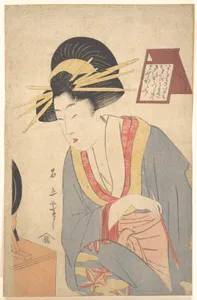
Little is known about Sekijō's artistic training, as his master lineage is unrecorded in historical sources. He worked firmly within the ukiyo-e tradition, specializing in bijin-ga (pictures of beautiful women) and genre scenes that captured the fleeting pleasures of urban life. Some art historical lists associate him with the Kitagawa school, linked to the influential master Kitagawa Utamaro, whose style of close-up portraits and elegant female figures echoes in Sekijō's delicate compositions. Sekijō's prints often featured intimate domestic moments, as seen in his polychrome woodblock depictions of courtesans, young lovers, and everyday elegance.
Among his surviving works, the late 18th-century *Woman Applying Make-up* stands out, a poignant bijin-ga now in the Metropolitan Museum of Art's collection, showcasing a woman in quiet introspection with ink and color on paper. He also illustrated popular literature, including self-authored kibyōshi (yellow-back novels) like *Sekijō San'nosuke Shinbō* (1791) and *Ichitoyomi Otafuku-gami* (1793), as well as gōkan such as *Fukuraku Jakkin Dekiru Aki* (1804, with Utagawa Toyahiro) and large-format nishiki-e prints like *Makigami o Nameru Oiran* (Courtesan Licking a Scroll) and *Wakashū to Oiran* (Youth and Courtesan). Other pieces, signed as Hisanobu, include *Hawking Party* and *Gonpachi and Komurasaki*.
Though not among the era's luminaries, Sekijō's multifaceted output bridged fine art prints and mass-market illustrated books, enriching Edo's vibrant print culture. His works preserve the era's social vignettes, from samurai tales to ribald humor, and continue to intrigue collectors and scholars for their rarity and stylistic finesse.