Ctrl K
1786–1860
Kawahara Keiga (also known as Toyosuke or Taguchi Takumi) was a leading late Edo-period painter born in Nagasaki in 1786 as the son of the artist Kawahara Kozan. He received early training as an apprentice in the family print shop before studying under the prominent Nagasaki painter Ishizaki Yūshi (1768–1846), Inspector of Chinese Painting, with whom he formed a lifelong mentor-disciple relationship. Yūshi’s sponsorship granted Keiga privileged access to Dejima, the Dutch trading post. In 1811 the Nagasaki authorities appointed him official painter to the Dutch factory, a position he held until 1842.
Keiga developed a distinctive style that fused traditional Japanese Yamato-e with Western techniques of perspective, shading, and scientific observation. In 1825 the Dutch artist Carl Hubert de Villeneuve taught him these methods, enabling highly realistic depictions of plants, animals, people, and landscapes. His most productive period came through collaboration with the German physician and naturalist Philipp Franz von Siebold (1823–1829), for whom he created hundreds of precise illustrations of Japanese flora, fauna, ethnography, and daily life. In 1826 he accompanied Siebold on the court journey to Edo, recording street scenes, landscapes, and court life along the 2,400-kilometre route.
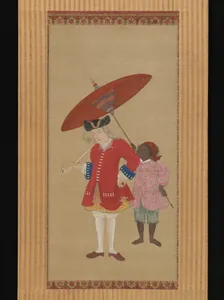
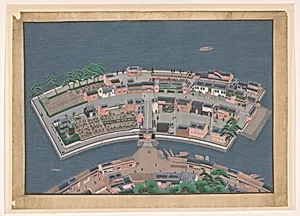
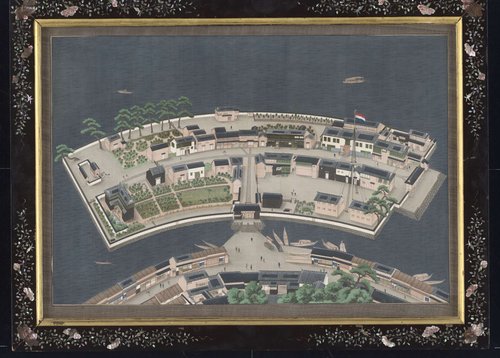
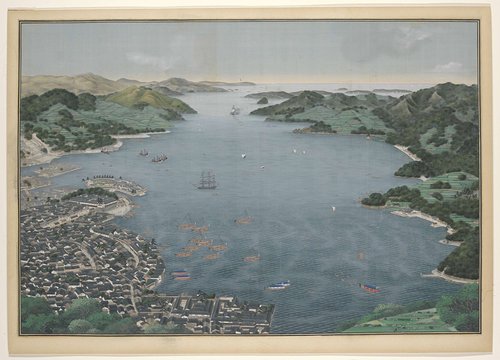
Among his major works are scientifically accurate botanical and zoological drawings later used in European publications by Siebold, Temminck, and Schlegel; panoramic views and folding screens of Nagasaki harbour and Dejima; portraits of Dutch officials such as Hendrick Doeff and of Japanese sitters; and scenes of life at the trading post. In 1846 he painted five ceiling panels of plants in the Yamato-e manner for Wakimisaki Kannonji temple (signed jointly with Yūshi). Despite imprisonment in 1829 over the Siebold “spy” incident and banishment from Nagasaki in 1842 for depicting family crests on harbour boats, he continued to receive commissions until his last known work, a portrait dated 1860.
Keiga’s oeuvre—often described as that of a “photographer without a camera”—offers an unparalleled visual record of Japan during sakoku isolation. Hundreds of his paintings survive in Dutch collections (notably the National Museum of World Cultures) and Japanese museums, documenting nature, culture, and the unique intercultural world of Dejima with a blend of Eastern lyricism and Western precision that remains invaluable to both art history and science.