
Ctrl K
1801–1900
Khooshal Dhunjee & Sons operated as a prominent workshop of painters and shield makers in Ahmedabad, Gujarat, during the nineteenth century. Based on Dhalgarwada Street in the city, the firm specialized in crafting and decorating round leather shields known as dhál, a traditional form of Indian armor that combined functionality with elaborate artistic embellishment. Their work reflects the skilled artisanal traditions of Gujarat, where leather was meticulously tooled, painted with vibrant pigments, and reinforced with brass elements to create both protective and visually striking objects.
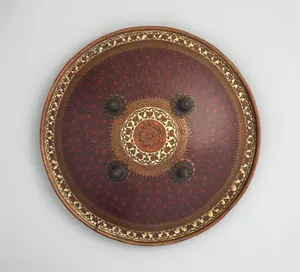
The firm’s artistic style centered on intricate floral and foliate motifs executed in repeating patterns across the convex surface of the shields. Typical examples feature a central medallion with symmetrical leaf-and-blossom designs, surrounded by undulating stalks and pebbled grounds in contrasting colors such as red, black, and off-white. Four symmetrically placed domed brass bosses added both structural strength and decorative emphasis. These shields exemplify the high level of technical refinement achieved by Gujarati craftsmen in the late nineteenth century, blending local painting techniques with the practical demands of armor production.
One of the most significant surviving works associated with the workshop is a finely preserved leather shield dated circa 1875, now in the collection of The Metropolitan Museum of Art. Measuring approximately 43 centimeters in diameter, it retains its original bright red interior bearing a gold-painted inscription that explicitly names the makers and their Ahmedabad address. This piece stands out for its exceptional quality, condition, and documentary value, distinguishing it from other unsigned Indian painted shields of the period. A comparable example is recorded as having been presented to the Prince of Wales, underscoring the workshop’s reputation for superior craftsmanship.
Khooshal Dhunjee & Sons left a lasting legacy as one of the few documented Indian arms producers of the colonial era whose identity is preserved through signed inscriptions. Their shields provide valuable insight into the continuity of traditional Gujarati metalworking and painting practices amid nineteenth-century trade and patronage networks. Though details of the individual family members remain limited, the firm’s output continues to be studied for its contribution to the material culture of Gujarat.