Ctrl K
1814–1866
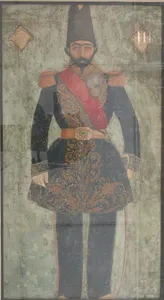
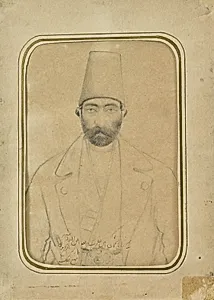
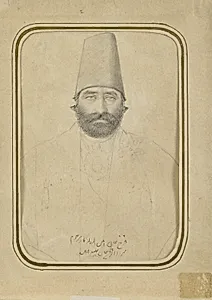
**Mirza Abu'l-Hasan Khan Ghaffari Kashani (1814–1866), better known as Sani' al-Mulk, was a leading Iranian painter, miniaturist, lacquer artist, and book illustrator of the Qajar era.** Born in Kashan to a family with a long artistic lineage—he was the son of Mīrzā Moḥammad Ḡaffārī and great-nephew of the earlier painter Abu'l-Hasan Mostawfi Ghaffari—he became one of eleven notable painters in his extended family. He is also remembered as the uncle of the celebrated later court painter Mohammad Ghaffari, known as Kamal ol-Molk.
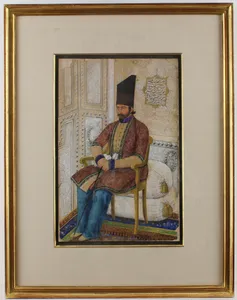
He trained initially under his father before becoming a pupil of the renowned court painter Mihr 'Ali, who had served Fatḥ 'Ali Shah. Early in his career, Abu'l-Hasan worked as a court painter for Mohammad Shah Qajar. After a period of political and financial upheaval at court, he traveled to Europe, spending significant time in Italy (particularly Rome, Florence, and Venice) studying Renaissance masters such as Raphael, Michelangelo, and Titian. He returned to Iran around 1850, bringing European techniques that he blended with traditional Persian pictorial traditions. His resulting style featured lifelike portraits marked by psychological depth, precise renderings of hands, feet, and expressions, and a modern realism distinct from more stylized earlier Persian painting.
Under Naser al-Din Shah, he rose to prominence as Chief Court Painter, earning the title Sani' al-Mulk (“Crafter of the Kingdom”). In 1861 he was appointed Director of Printing and Chief Illustrator, overseeing the court newspaper and establishing a royal art school where he taught lithography. His most celebrated project was supervising the lavish six-volume illustrated manuscript of *One Thousand and One Nights* (1853 onward), created with a team of thirty-four artists; the work, preserved today in Tehran’s Golestan Palace Library, contains over a thousand pages and thousands of miniatures.
Sani' al-Mulk’s legacy lies in his role as a bridge between Persian artistic heritage and European academic traditions. By introducing lithography, realistic portraiture, and public dissemination of images through print, he helped modernize Iranian visual culture and trained a new generation of artists. His portraits of Qajar dignitaries and royal figures remain prized examples of 19th-century Iranian painting, and his influence extended through both his direct pupils and his nephew Kamal ol-Molk.