
Ctrl K
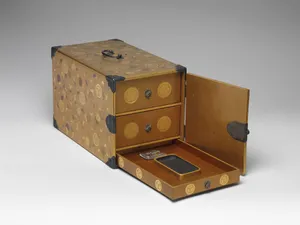
1750–1799
**Kōami School** was a distinguished lineage of Japanese lacquer artists renowned for their mastery of maki-e techniques, active across centuries and particularly prominent in the Edo period. Flourishing for nineteen generations from the Muromachi era through the Tokugawa (Edo) period, the school specialized in sophisticated lacquerware that combined technical precision with elegant designs. The dates 1750–1799 place its activity firmly in the late eighteenth century, when members continued the family tradition in Edo (modern Tokyo), producing refined works for elite patrons.
The school traces its origins to Kōami Dōchō (also known as Michinaga, 1410–1478), the first lacquer master linked to specific surviving works. He excelled in takamaki-e (relief maki-e using lacquer putty and metal foils) and togidashi maki-e (a polished technique revealing sprinkled gold or silver designs beneath translucent layers). Dōchō modeled many motifs on paintings by contemporary artists such as Kanō Motonobu, establishing a practice of collaborative design that became a hallmark of the school. Subsequent generations, including his son Michikiyo, expanded this approach, creating furnishings and decorative objects for imperial and shogunal households.
Artistically, the Kōami School worked within the broader maki-e tradition, one of Japan’s two major lacquer schools alongside the Igarashi. Their style emphasized intricate, often narrative or nature-inspired patterns executed with gold, silver, and other metal powders on lacquered surfaces. In the eighteenth century, members maintained the family’s reputation for high-relief and polished techniques, adapting classical motifs to contemporary tastes while serving the bakufu (military government). A notable example from the broader school output includes elaborate portable writing cabinets and inrō featuring gold and silver takamaki-e.
The Kōami legacy endures as a cornerstone of Japanese decorative arts. By establishing a formal lacquerware school in Edo, later generations ensured the transmission of specialized skills across more than three centuries. Their innovations in maki-e helped define the luxurious aesthetic of Edo-period lacquerware, influencing subsequent artists and preserving techniques still studied and practiced today. Though only one work from the 1750–1799 period is highlighted in certain collections, the school’s collective output represents a pinnacle of craftsmanship in Japanese art history.
All 1 artworks loaded