Ctrl K
1536–1612
**Konoe Sakihisa (1536–1612)** was a prominent Japanese court noble (kuge) of the Konoe family, a leading branch of the Fujiwara clan, whose life bridged the turbulent Sengoku period and the cultural flourishing of the Momoyama era. Born in Kyoto as the son of regent Konoe Taneie, he rose through the ranks of imperial court service, holding positions including kampaku (regent) during the reign of Emperor Go-Nara, sadaijin, and ultimately daijō-daijin, attaining the junior first rank. His political influence extended beyond the court; he cultivated ties with warlords such as Oda Nobunaga and later adopted Toyotomi Hideyoshi, granting the latter Fujiwara lineage legitimacy that facilitated his own rise to kampaku.
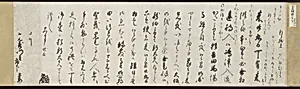
Beyond his statesmanship, Sakihisa distinguished himself as a skilled calligrapher and poet. He mastered the Shōren-in school of calligraphy, a refined tradition emphasizing elegant brushwork, and was celebrated in his time as one of the most talented calligraphers among the courtier-poets. His literary talents encompassed waka and renga poetry; he is credited with composing the Saga-ki, a notable work reflecting courtly aesthetics. These pursuits aligned with the refined sensibilities of the Heian court revival during the Momoyama period, often executed on sumptuously decorated papers featuring gold, silver, and dyed motifs.
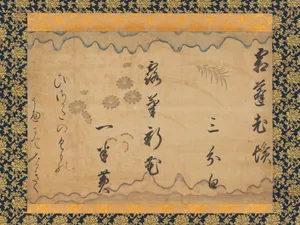
Among his surviving works are exquisite examples of calligraphy, including a handscroll section from the influential anthology *Wakan rōeishū* (“Japanese and Chinese Poems to Sing”), featuring a Chinese couplet by Bai Juyi paired with a waka by Fujiwara no Toshiyuki, rendered in a sophisticated mix of kanji and kana on cloud-patterned paper. Additional attributions include poems on colored paper preserved in collections such as the Kyoto National Museum, underscoring his command of both formal scripts and poetic expression.
Sakihisa’s legacy endures through his artistic contributions and his family’s cultural prominence—his son Konoe Nobutada continued the family’s calligraphic tradition. As a bridge between political power and aesthetic refinement, he embodied the ideal of the cultivated court noble during Japan’s transition into the early modern age, with his works exemplifying the elegance and technical mastery prized in Momoyama court circles. His pieces remain valued today for their insight into the intersection of poetry, calligraphy, and aristocratic life.