Ctrl K
1585–1669
Occupations
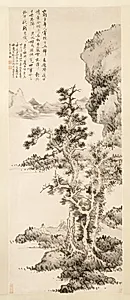
Lan Ying (ca. 1585–1664), courtesy name Tianshu, was a prolific Chinese painter born in Hangzhou, Zhejiang province, during the late Ming dynasty. Known by the pseudonym Xihu Waishi ("Unofficial Historian of the West Lake"), he specialized in landscapes, human figures, flowers, and birds, drawing inspiration from the literati tradition and meticulously studying the works of Yuan masters like Huang Gongwang and Wu Zhen, as well as Wu School artists such as Shen Zhou. While his early life remains sparsely documented, Lan displayed remarkable talent from a young age and worked within the professional Zhe School tradition, of which he is regarded as the last major practitioner—a lineage originating with Dai Jin that emphasized technical virtuosity and vivid coloristic effects. He also founded the Wulin School in Hangzhou, blending Song and Yuan idioms with late Ming scholar-painting aesthetics to create an elegant, eclectic style marked by expressive drawing, bold colors, and monumental compositions evoking reclusive hermit life.
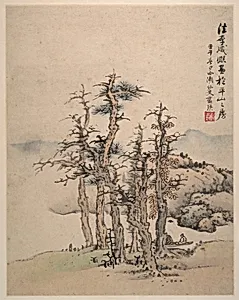
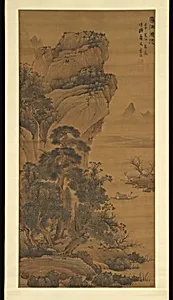
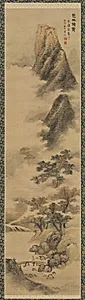
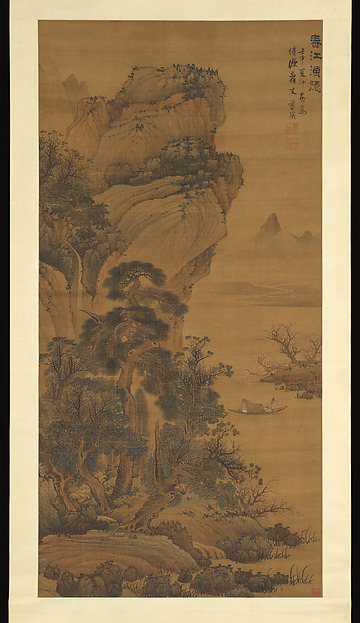
Lan Ying's oeuvre is vast, with works often emulating ancient masters while showcasing his innovative flair. Notable examples include *Peach Forest* (Honolulu Museum of Art), *Hermit-Fisherman on a Spring River* (1632, Metropolitan Museum of Art), and *Landscape after Wu Zhen*, alongside *Autumn Colors among Streams and Mountains*, *Fisherman-recluses in Autumn Mountains*, *Lofty Recluses in Cloudy Valleys*, and *White Clouds and Red Trees*. A standout is his *Huayue Gaoqiu Tu Zhou* (Mt. Hua in High Autumn, 1652), a hanging scroll capturing dramatic seasonal vistas.
His legacy endures through family and pupils: sons Lan Meng (or Lan Yu) and grandson Lan Shen continued his style, producing similar monumental landscapes, while the young Chen Hongshou trained under him in Hangzhou between ages ten and twenty, copying Song-style pictures in the Zhe tradition. Lan's influence extended to the Eight Masters of Jinling, bridging professional and literati painting as Ming transitioned to Qing, cementing his role as a pivotal figure in transitional Chinese art.
Wikidata (CC0); Getty ULAN (ODC-By)
All 6 artworks loaded