Ctrl K
Lawrence Nelson Wilbur (1897–1988) was an American painter and printmaker whose career bridged commercial engraving and fine art over seven decades. Born in Whitman, Massachusetts, he began his professional training in Boston as a photoengraver before moving to Los Angeles in 1921, where he worked in the engraving department of the Los Angeles Times. In 1925, Wilbur relocated to New York City, enrolling at the Grand Central Art School, where he studied under renowned illustrators N.C. Wyeth, Harvey Dunn, and Pruett Carter. This formal education, combined with his technical expertise in graphic arts, honed his skills as a meticulous draftsman, enabling him to excel in both painting and printmaking.
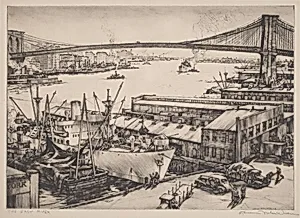
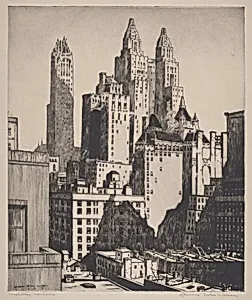
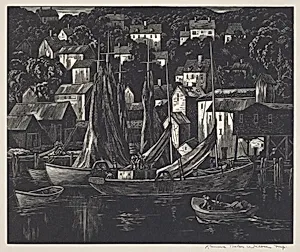
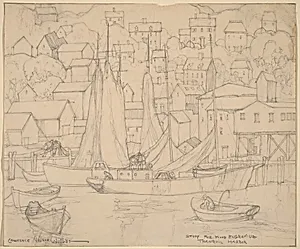
Settling in New York, Wilbur balanced freelance engraving for top shops and major magazines with his pursuit of fine arts. His style emphasized precise, realist depictions of urban life, capturing the grit and grandeur of Manhattan alongside coastal scenes from Gloucester, Massachusetts. Working in oils, etchings, drypoints, wood engravings, woodcuts, linoleum blocks, and lithographs, he produced evocative works like *Manhattan Mountains* (1938), *42nd Street & 5th Avenue* (1938), *Times Square Subway* (1941), and *East River* (1946 drypoint). Later paintings such as *Tranquil Harbor, Gloucester* (1951) and *Boat Yard, Gloucester Harbor* (1966) reflected his affinity for New England maritime subjects.
Wilbur's output continued into his later years, with pieces like *Old Brownstones—New York* (1983), *The Spire—New York* (1985), and *Under the Bridge—New York* (1985) showcasing enduring vitality. He earned the Audubon Artists' medal of honor in 1957 for an oil self-portrait and contributed to magazine covers, including *The Artist* in 1937.
His legacy endures in prestigious collections, including the Metropolitan Museum of Art, National Gallery of Art, Library of Congress, and Philadelphia Museum of Art. A member of the Salmagundi Club, Painters and Sculptors Society of New Jersey, and Society of American Graphic Artists, Wilbur's blend of commercial precision and artistic vision exemplifies the American Scene tradition, bridging illustration and modernism for generations of viewers.
All 4 artworks loaded