Ctrl K
1862–1934
Charles-Lucien Léandre (1862-1934) was a prolific French caricaturist, lithographer, and painter who became one of the most celebrated satirical artists of the Belle Époque. Born in Champsecret in Normandy, Léandre achieved fame through his witty caricatures published in leading French periodicals, particularly Le Rire and L'Assiette au Beurre, where his series "Gotha des souverains" (Who's Who of Sovereigns) established his reputation as a master of political and social satire. While Léandre exhibited paintings and genre pictures at the Paris Salon throughout his career, his popular fame rested on his comic drawings and caricatures that captured the personalities, follies, and pretensions of Third Republic France. His work combined sharp observational skills with graphic clarity, creating memorable images that were both humorous and psychologically penetrating. Beyond caricature, Léandre was an accomplished lithographer who designed influential Art Nouveau posters and published numerous albums including Nocturnes, Le Musée des souverains, and Paris et la Provence.
Charles-Lucien Léandre was born on July 23, 1862, in Champsecret, a commune in the Orne department of Normandy, France. Growing up in rural Normandy during the Second Empire and early Third Republic, Léandre developed observational skills and a sense of regional character that would later inform his artistic practice.
Léandre pursued formal artistic training in Paris, studying painting under Émile Bin and the renowned academic painter Alexandre Cabanel. Cabanel was one of the leading figures of the French Academy, known for his mythological paintings and technical virtuosity. This academic training provided Léandre with solid technical foundations in drawing, composition, and painting.
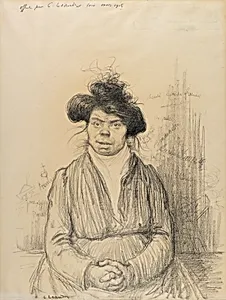
Despite his academic training in the grand tradition of French painting, Léandre found his true calling not in historical or mythological subjects but in the observation of contemporary life and character. His ability to capture individual physiognomy and personality through economical, expressive lines would become his defining strength.
Beginning in 1887, Léandre became a regular exhibitor at the Paris Salon, France's official annual art exhibition. At the Salon, he showed numerous portraits and genre pictures, demonstrating his competence in traditional painting and building his reputation within official art circles.
However, Léandre's popular fame came not from his Salon paintings but from his work in the burgeoning illustrated press. The late nineteenth century saw an explosion of illustrated newspapers and magazines in France, creating unprecedented opportunities for artists skilled in caricature and satirical drawing.
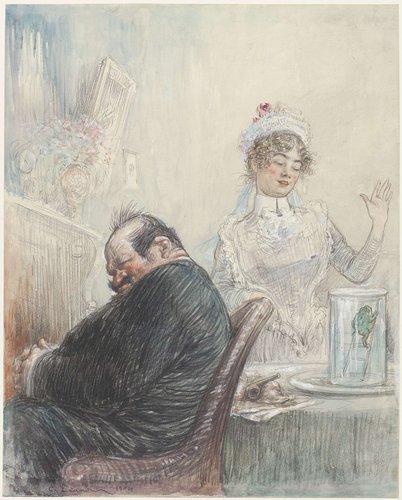
Léandre's caricatures began appearing in various Parisian publications, where his ability to distill individual character into a few essential lines attracted attention. His style combined the observational acuity necessary for recognizable portraiture with the graphic exaggeration that makes caricature effective, creating images that were both true and hilariously distorted.
During this period, Léandre developed the technical skills in lithography and printmaking that would distinguish his work. Unlike artists who merely drew for reproduction by professional lithographers, Léandre mastered the lithographic process himself, maintaining direct control over the translation of his drawings into printed images.
Léandre's breakthrough came with his work for Le Rire (Laughter), one of the most successful illustrated satirical magazines of the Belle Époque, founded in 1894. For Le Rire, Léandre created his famous series "Gotha des souverains" (Who's Who of Sovereigns), caricaturing European royalty and heads of state with devastating wit and graphic economy.
The "Gotha des souverains" series established Léandre as one of France's premier caricaturists. His portraits of monarchs, presidents, and political figures captured not just physical likenesses but also suggestions of character—vanity, pomposity, weakness, or cunning—through subtle distortions and expressive emphasis.
Léandre also contributed extensively to L'Assiette au Beurre (The Butter Dish), another influential satirical magazine known for its social and political commentary. His work for these publications positioned him at the center of French visual satire during the Third Republic.
In 1904, recognizing the unique position of humorous artists in French culture, Léandre founded the Société des Peintres Humoristes (Society of Humorous Painters), an organization that elevated the status of caricature and comic art by providing a professional association comparable to those serving more traditional artists.
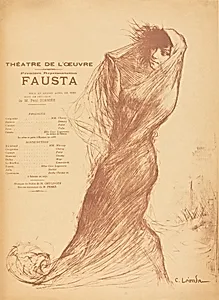
Beyond magazine illustration, Léandre distinguished himself as a poster designer during the Art Nouveau period. His posters combined the period's characteristic flowing lines and decorative elements with his gifts for caricature and graphic communication, creating memorable images that functioned as both advertisement and art.
Léandre produced "admirable work in lithography," as contemporary critics noted, designing posters that became iconic images of Belle Époque Paris. His mastery of the lithographic medium allowed him to achieve both graphic boldness and subtle tonal effects.
He published a series of successful albums that collected his work: Nocturnes, Le Musée des souverains, and Paris et la Provence. These publications brought his caricatures and illustrations to a wider audience and established his work as collectible art rather than merely ephemeral journalism.
Léandre's contributions to French visual culture received official recognition through the Legion of Honor. He was created a Knight (Chevalier) of the Legion of Honor and in 1925 was promoted to Officer, acknowledging his service to French art. In 1921, he received the Medal of Honour of the Société des artistes français in the engraving section, specifically recognizing his printmaking achievements. Charles-Lucien Léandre died on May 24, 1934, in his Montmartre studio on Caulaincourt Street, having documented half a century of French social and political life through his incisive, humorous eye.
Artheon Research Team
Last updated: 2025-11-09
Biography length: ~477 words
All 3 artworks loaded