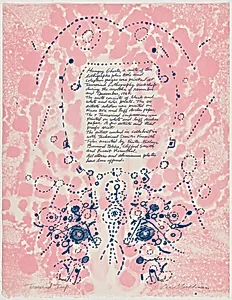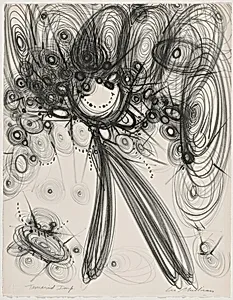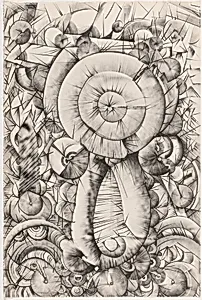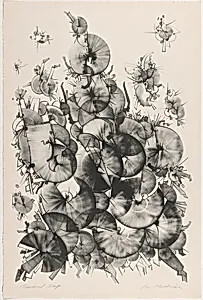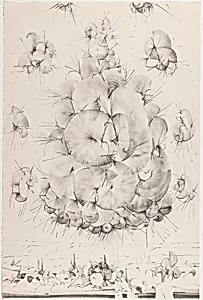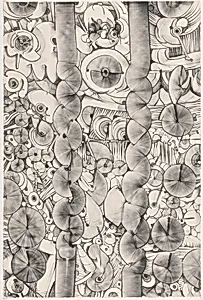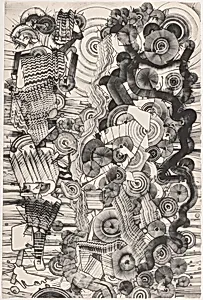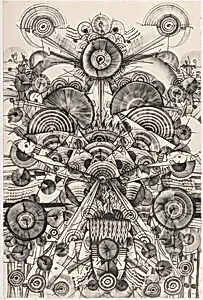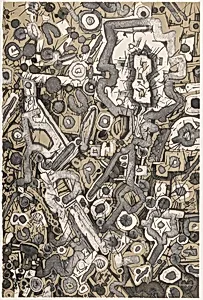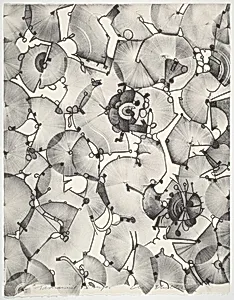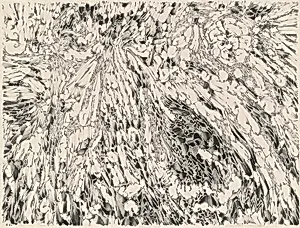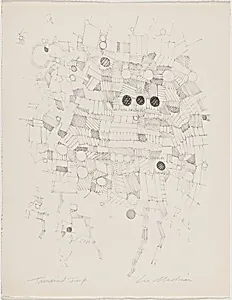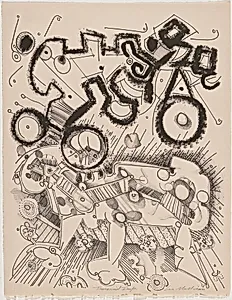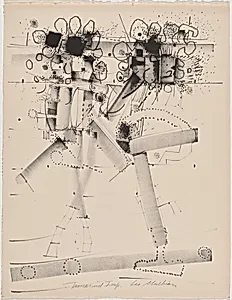
Lee Mullican was an American painter whose visionary, intensely patterned canvases placed him at the intersection of Abstract Expressionism, Surrealism, and non-Western spiritual traditions. Born in 1919 in Chickasha, Oklahoma, he studied at the Kansas City Art Institute and later at the University of Oklahoma before serving as a cartographer in the United States Army during World War II. That experience — mapping terrain from aerial surveys — left traces in his mature art, with its bird's-eye perspectives, dense layered surfaces, and sense of landscape seen from a transcendent remove.
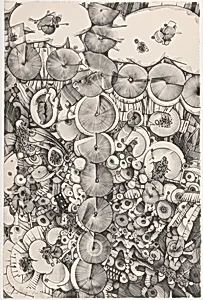
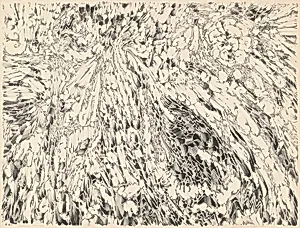
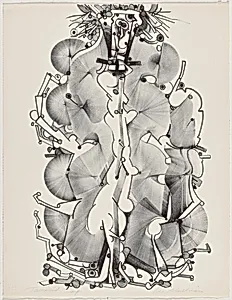
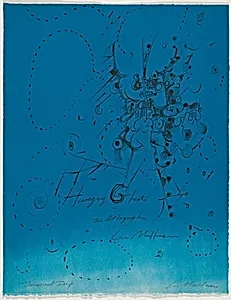
After the war, Mullican settled in San Francisco, where he became a founding member of the Dynaton group in 1951, alongside the painter Wolfgang Paalen and the artist Gordon Onslow Ford. The Dynaton movement, whose name derived from the Greek word for "the possible," was devoted to exploring inner and outer realities through art, drawing on Surrealist automatism, pre-Columbian and indigenous art, and Eastern philosophy. Mullican's contribution to the group was a distinctive painting technique: he applied paint to canvas using a palette knife held vertically, creating thousands of short, parallel strokes that gave his surfaces a vibratory, almost electrostatic quality.
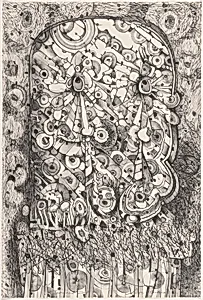
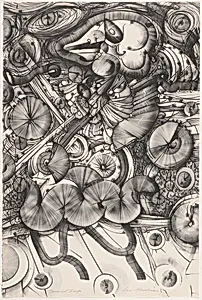
This technique, which Mullican maintained throughout his long career, produced images of remarkable density and optical intensity — cosmic landscapes, interior visions, and abstract configurations that seem to pulse with energy. His palette ranged from deep earth tones to brilliant, jewel-like chromatics, and his compositions often suggest both organic growth and cosmic order simultaneously. He taught for many years at the University of California, Los Angeles, where he influenced generations of younger artists.
Mullican died in 1998, and his work has attracted growing critical attention in the years since, recognized as a significant and singular contribution to postwar American abstraction. His paintings bridge the spiritually inflected abstraction of the mid-century with concerns — pattern, texture, non-Western visual traditions — that would become central to art of later decades. Major museum collections in the United States hold his work, and retrospective exhibitions have helped secure his place in the broader narrative of American modernism.