Ctrl K
1626–1676
Occupations
Cornelis Lelienbergh, a prominent still-life painter of the Dutch Golden Age, was born around 1626 in The Hague, where he spent much of his career. Little is known of his early training, but by age 20, in 1646, he gained admission to the city's Guild of Saint Luke, paying the non-resident fee, which suggests he may have apprenticed elsewhere before establishing himself locally. In 1649, he married Agnieta Abrahams van der Hennis, daughter of an art dealer; the couple had several children baptized in The Hague between 1650 and 1662.
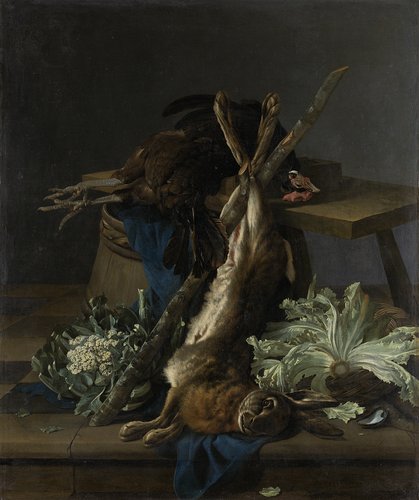
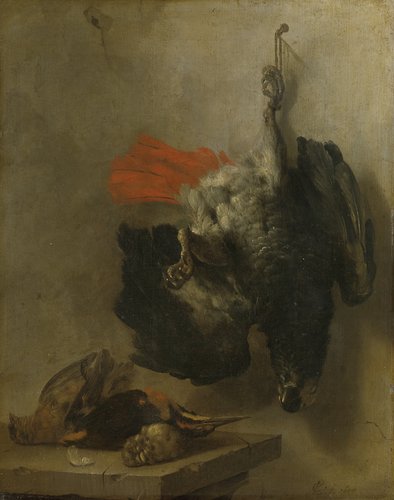
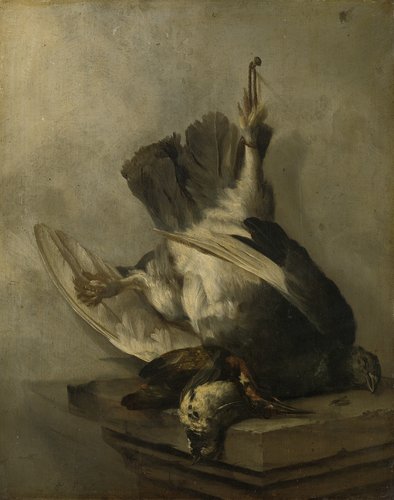
Lelienbergh rose to prominence in mid-seventeenth-century The Hague as the leading specialist in game still lifes, renowned for his meticulous rendering of feathers, fur, and textures on dead birds and mammals. His compositions evolved from intimate tableaus influenced by predecessors like Elias Vonck and Matthijs Bloem to more dramatic hunting trophy arrangements by the 1650s, often incorporating kitchen utensils, fruits, or hunting gear. A member of the civic guard in 1654, he co-founded the rival Confrerie Pictura artists' society in 1656, bought a house on Nieuwe Molstraat in 1657, and solidified his status among the city's painters.
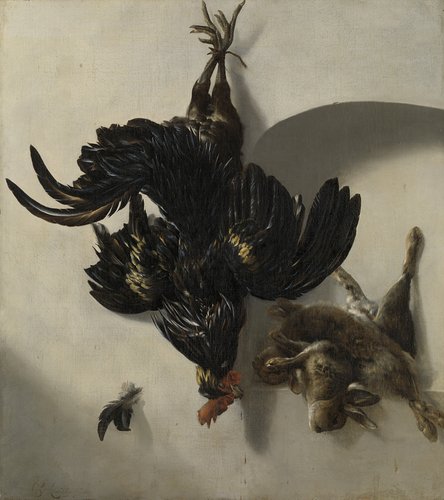
Among his notable works are *Still Life of Dead Birds* (1654, Philadelphia Museum of Art), *Still Life with Woodpecker and Snipes* and *Still Life with Parrot and Snipes* (both 1655, Rijksmuseum, Amsterdam), *Still Life with Black Rooster and Two Rabbits* (1659, Rijksmuseum), and *Dead Game and Hunting Equipment* (1671, Musée d'Ixelles, Brussels). These paintings exemplify his skill in capturing the opulent bounty of the hunt, blending realism with subtle narrative tension.
Around 1666, Lelienbergh briefly served as a clerk at Fort Moerspui in Zeeuws-Vlaanderen before returning to The Hague, where he remained active until after 1680. Though his life details are sparse, his prolific output influenced later artists like Frank Pietersz. Verheyden, cementing his legacy as a master of the game still-life genre in Dutch art. Today, his works grace collections worldwide, offering vivid glimpses into the era's fascination with nature's transience and abundance.
Wikidata (CC0); Getty ULAN (ODC-By)