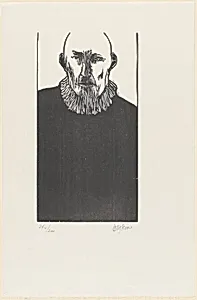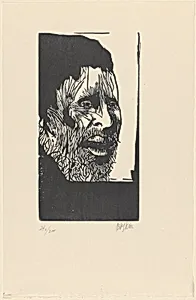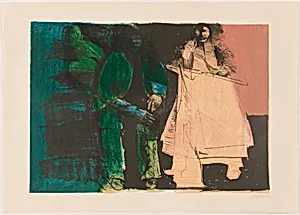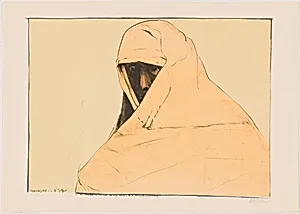
Leonard Baskin (1922–2000) was a towering figure in American art, renowned for his monumental sculptures, powerful woodcuts, and intricate book illustrations that grappled with the human condition's darker facets. Born in New Brunswick, New Jersey, to a family of rabbis, he moved to Brooklyn's Jewish Orthodox Williamsburg neighborhood at age seven. Vowing to become a sculptor at 15, Baskin apprenticed under Maurice Glickman at New York's Educational Alliance from 1937 to 1939, honing his skills in classical and modern techniques. He continued at New York University's School of Architecture and Applied Arts (1939–1941), earned a scholarship to Yale's School of Fine Arts (1941–1943), and later obtained a B.A. from the New School for Social Research in 1949, with further studies at Paris's Académie de la Grande Chaumière and Florence's Accademia di Belle Arti in 1950–1951.
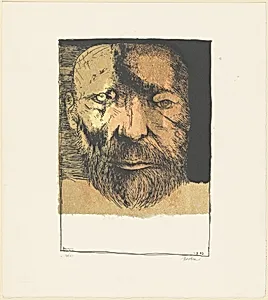
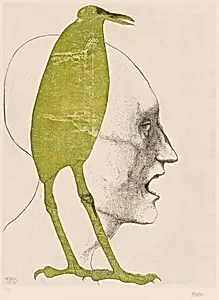
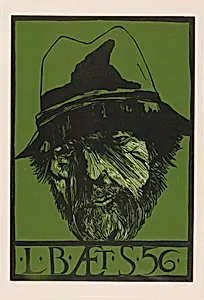
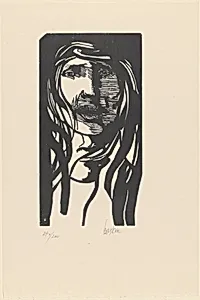
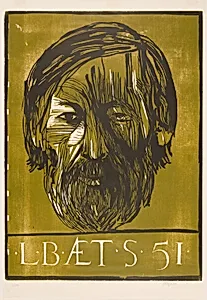
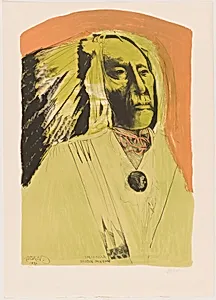
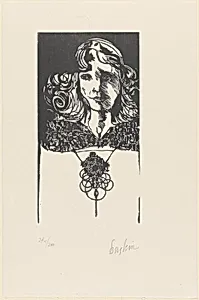
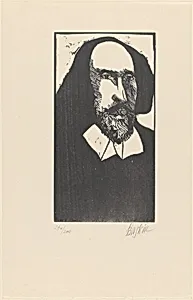
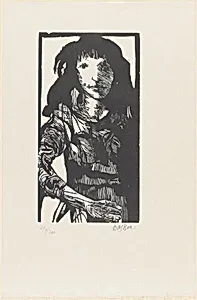
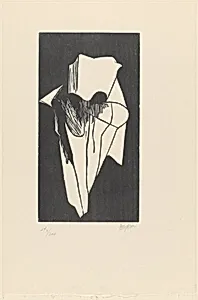
Baskin's style rooted in Boston Expressionism emphasized grotesque, angst-ridden figures—bloated, hybrid human-animal forms evoking mortality, the Holocaust, and Jewish themes—inspired by William Blake and German Expressionists like Ernst Barlach. His woodcuts, such as the life-size *Hydrogen Man* (1954), a hollowed-out figure responding to nuclear horrors, and *The Hanged Man* (1955), captured tortured vulnerability through bold negative space and veined lines. Sculptures like *The Altar* (1977), fusing Abraham, Isaac, an angel, and ram in lindenwood, and late bronzes including *The Funeral Cortege* (1994) for the FDR Memorial and the Ann Arbor Holocaust Memorial (1994) embodied raw emotional states from fear to mercy.
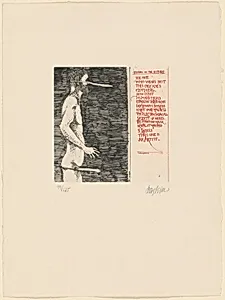
In 1942, while at Yale, Baskin founded the Gehenna Press, producing over 100 finely crafted books with poets like Sylvia Plath (to whom he dedicated her "Sculptor") and Ted Hughes, revolutionizing American fine printing. He taught printmaking and sculpture at Worcester Art Museum (1952–1953) and Smith College (1953–1973), influencing generations before returning from Britain in 1984 to Hampshire College. Married twice—first to Esther (mother of son Tobias), then Lisa Unger Baskin (parents of Hosea and Lucretia)—his oeuvre graces museums worldwide, from the Met to the Vatican, cementing his legacy as a humanist master of the figure amid 20th-century horrors, honored with a Guggenheim, Prix de Rome, and Library of Congress retrospective.