Ctrl K

1452–1519
Movements
Occupations
Leonardo da Vinci (1452-1519) stands as the quintessential Renaissance polymath, whose genius spanned painting, sculpture, architecture, science, mathematics, engineering, anatomy, geology, cartography, botany, and writing. Born in Vinci, Italy, as the illegitimate son of a notary, Leonardo received limited formal education but demonstrated extraordinary artistic talent from an early age. His apprenticeship under Andrea del Verrocchio in Florence provided him with comprehensive training in painting, sculpture, and the technical-mechanical arts, launching a career that would revolutionize Western art and scientific inquiry. Leonardo's artistic innovations, particularly his development and mastery of sfumato and chiaroscuro techniques, created paintings of unprecedented psychological depth and naturalism. His most celebrated works, the Mona Lisa and The Last Supper, remain among the most recognizable and influential paintings in history. The Mona Lisa's enigmatic smile and revolutionary three-quarter pose established new standards for portraiture, while The Last Supper's masterful handling of space, perspective, and human emotion became a definitive model for religious art. Beyond his artistic achievements, Leonardo's insatiable curiosity drove groundbreaking investigations into human anatomy, engineering, optics, hydrodynamics, and natural phenomena. His notebooks, containing over 13,000 pages of observations, sketches, and inventions, reveal a mind centuries ahead of its time. Though he dissected approximately 30 human corpses and made pioneering anatomical discoveries, including the four-chambered heart and the maxillary sinus, his findings remained unpublished during his lifetime. Leonardo spent his final years in France under the patronage of King Francis I, dying at age 67 in 1519, leaving behind a legacy that continues to inspire artists, scientists, and thinkers worldwide.
Leonardo was born on April 15, 1452, in Vinci, a small town near Florence, as the illegitimate son of Ser Piero, a 25-year-old notary, and Caterina, a peasant woman. His father took custody of him shortly after birth, and growing up in his father's household, Leonardo had access to scholarly texts owned by family and friends. Though he received little formal education beyond basic reading, writing, and mathematics, his artistic talents manifested early and unmistakably.
Around 1467, when Leonardo was approximately 15 years old, his father recognized his son's extraordinary abilities and apprenticed him to Andrea del Verrocchio, one of Florence's most renowned artists. Verrocchio ran a prestigious workshop that undertook diverse commissions including painting, sculpture, and decorative metalwork. Under Verrocchio's tutelage, Leonardo received multifaceted training in painting, sculpture, and the technical-mechanical arts. The young artist's genius became evident in collaborative works produced between 1470 and 1475, most notably when he painted an angel in Verrocchio's 'Baptism of Christ' with such superior skill that legend claims Verrocchio resolved never to paint again.
In 1472, Leonardo was accepted into the painters' guild of Florence, marking his official recognition as a master artist. However, he remained in Verrocchio's workshop for five additional years, continuing to refine his skills and develop his distinctive approach. This extended apprenticeship provided Leonardo with an exceptionally thorough foundation in Renaissance artistic principles and practices. After 1477, he worked independently in Florence, taking on his own commissions and beginning to establish his reputation as an artist of remarkable talent and innovation.
In 1482, Leonardo moved to Milan, entering the service of Ludovico Sforza, the Duke of Milan. This transition marked a crucial phase in his career, as he assumed the remarkable dual role of principal military and naval engineer while simultaneously serving as master painter and sculptor. Leonardo's versatility flourished in this environment, where he pursued diverse projects ranging from military engineering and architectural designs to theatrical productions and artistic commissions. The intellectual atmosphere of the Sforza court encouraged his multidisciplinary investigations.
During this period, Leonardo began systematically recording his observations and ideas in notebooks, a practice he would maintain throughout his life. From the mid-1480s onward, these notebooks reveal his relentless curiosity spanning subjects from military technology and acoustics to anatomy and mechanics. He acquired his first human skull in 1489, initiating anatomical studies that would continue for decades. His notebooks demonstrate a systematic approach to understanding the natural world that was centuries ahead of contemporary thought.
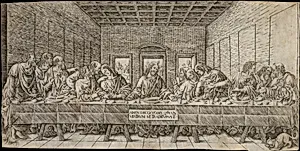
The Milan period culminated in Leonardo's creation of The Last Supper (1495-1498), commissioned for the refectory of the Convent of Santa Maria delle Grazie. This monumental mural depicts the moment when Christ announces that one of his apostles will betray him, capturing the disciples' varied emotional responses through masterful gestures, facial expressions, and poses. The painting's revolutionary handling of space, perspective, and psychological drama established it as one of the most influential works in Western art. Leonardo's innovative composition became a standard reference for subsequent generations of artists, including Rubens and Rembrandt, fundamentally shaping the trajectory of religious painting.
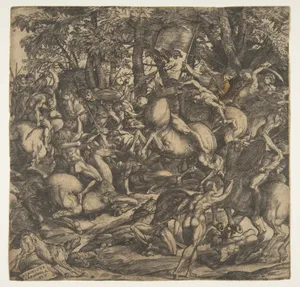
After the fall of Ludovico Sforza in 1499, Leonardo returned to Florence, where he found himself in the company of other emerging masters including the young Michelangelo. In January 1504, Leonardo participated in a meeting of Florence's most prominent artists to determine the placement of Michelangelo's nearly completed David. This period witnessed an intense rivalry between Leonardo and Michelangelo when both were commissioned to paint vast battle scenes on the same wall in the Council Hall of Florence's Palazzo Vecchio. Though neither project was completed, the competition highlighted the different approaches and philosophies of these two Renaissance giants.
During this Florentine period, Leonardo began work on his most famous painting, the Mona Lisa (c. 1503-1519), depicting Lisa Gherardini, wife of a Florentine merchant. The portrait exemplifies Leonardo's perfected sfumato technique, with subtle gradations of light and shadow creating the subject's mysterious, softly modeled features and enigmatic smile. Leonardo broke with traditional portraiture conventions by depicting the subject in a three-quarter pose rather than the customary profile, possibly becoming the first Italian artist to employ this composition, which subsequently became the standard approach. The painting's psychological depth, technical mastery, and enduring mystery have made it arguably the world's most famous artwork.
Leonardo also created The Virgin and Child with Saint Anne (c. 1503-1519) during this period, a work that profoundly influenced contemporary artists including Michelangelo, Raphael, and Andrea del Sarto. His anatomical investigations intensified, with his most penetrating studies beginning in 1506 when he dissected a 100-year-old man whose peaceful death he had witnessed. These dissections, eventually encompassing approximately 30 corpses, resulted in remarkably accurate anatomical drawings that revealed Leonardo's evolving understanding of human physiology and represented groundbreaking contributions to medical knowledge.
Between 1513 and 1516, Leonardo spent time in Rome, though this period proved less productive artistically than his earlier years. The papal court favored younger artists like Michelangelo and Raphael, who were actively working on major Vatican commissions. During these years, Leonardo increasingly focused on his scientific investigations, continuing his anatomical studies and engineering designs. He made substantial discoveries in anatomy, civil engineering, hydrodynamics, geology, optics, and tribology, though he never published these findings, limiting their immediate impact on subsequent science.
Leonardo's engineering genius manifested in conceptual designs far ahead of his time. He envisioned flying machines, parachutes, helicopters, armored fighting vehicles, concentrated solar power, automobiles, and advanced weaponry. His approach to mechanical design was rigorously analytical, utilizing principles of leverage, cantilevering, pulleys, cranks, gears (including angle gears and rack and pinion systems), parallel linkage, lubrication systems, and bearings. He understood momentum, centripetal force, friction, and aerodynamic principles, applying these concepts to his inventions with unparalleled mastery. His technical drawings, including perfected 'exploded view' techniques, essentially created the modern form of technical illustration.
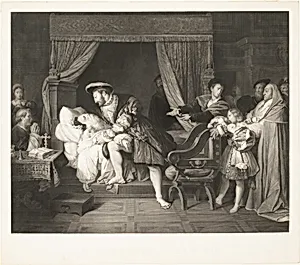
In 1516, Leonardo accepted the invitation of French King Francis I to serve as 'Premier Painter and Engineer and Architect to the King.' This generous offer allowed him to paint and pursue his investigations at leisure while residing at the Château of Cloux near Amboise in France. Leonardo brought several paintings with him, including the Mona Lisa, which he continued to refine. He died at Cloux on May 2, 1519, at age 67, possibly from a stroke. He named his devoted pupil Francesco Melzi as principal beneficiary of his estate. Melzi's careful preservation of Leonardo's notebooks and drawings ensured that future generations could access the master's extraordinary legacy of artistic and scientific achievement.
Artheon Research Team
Last updated: 2025-11-28
Biography length: ~1,247 words
Wikidata/Wikimedia Commons
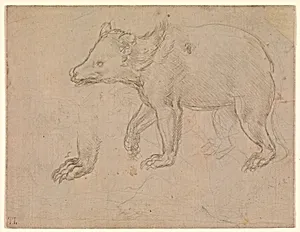
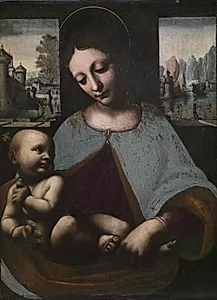
![Ginevra de' Benci [obverse]](https://images.artheonmuseum.org/nga/thumb/ginevra-de-benci-obverse-nga-50724.webp)
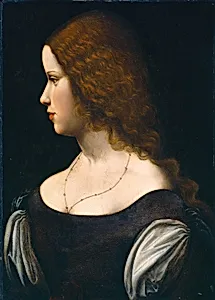
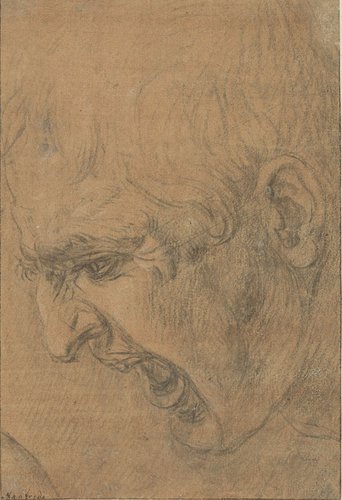

![Wreath of Laurel, Palm, and Juniper with a Scroll inscribed Virtutem Forma Decorat [reverse]](https://images.artheonmuseum.org/nga/thumb/wreath-of-laurel-palm-and-juniper-with-a-scroll-nga-50725.webp)
![Study of a Madonna [verso]](https://images.artheonmuseum.org/nga/thumb/study-of-a-madonna-verso-nga-74164.webp)
![Sheet of Studies [recto]](https://images.artheonmuseum.org/nga/thumb/sheet-of-studies-recto-nga-74163.webp)