
Ctrl K
1770–1813
**Jean-Galbert Salvage (1770–1813)** was a French anatomist, army surgeon, and artist whose work bridged medicine and the fine arts in post-revolutionary France. Born in Saint-Flour, he served as a military doctor at the Val-de-Grâce hospital during the Napoleonic era. There he combined his medical expertise with artistic practice, dissecting cadavers—often those of soldiers—and creating detailed anatomical studies to aid artists in accurately rendering the human form.
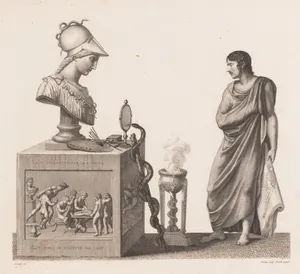
Salvage trained himself in drawing and the art of plaster casting, producing monumental écorchés (flayed figures) that revealed underlying musculature and skeletal structure. His most significant contribution is the 1812 publication *Anatomie du gladiateur combattant applicable aux beaux-arts*, a lavishly illustrated folio that applied anatomical knowledge directly to classical sculpture and artistic training. The work featured his own drawings and sculptures, with certain plates engraved by the Russian artist Nikolai Utkin.
Though his career was cut short by his death in 1813 at Lavastrie, Salvage’s anatomical models and publications left a lasting mark on artistic education. His innovative approach—grounding classical ideals in empirical dissection—influenced subsequent generations of artists and anatomists seeking scientific precision in the depiction of the body. Today his prints and studies are held in major museum collections, including the Metropolitan Museum of Art, where they continue to illustrate the intersection of science and aesthetics in early nineteenth-century France.