
Ctrl K
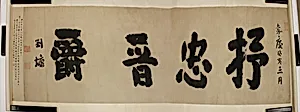
1719–1805
Liu Yong (1719–1805), courtesy name Chongru and art name Shi’an, was a distinguished Qing dynasty statesman and one of China’s most celebrated calligraphers. Born in Zhucheng, Shandong, into a prominent official family as the son of Grand Councilor Liu Tongxun, he received a rigorous Confucian education from an early age, studying at a private school in the Chahé Mountain Villa and entering the Imperial Academy as a student at sixteen. He earned the jinshi degree in 1751 and rose through a series of high offices, including Minister of Rites, Minister of Personnel, and Grand Secretary of the Tiren Hall, while serving as chief tutor to imperial princes, among them the future Jiaqing Emperor. Renowned for his integrity amid widespread corruption, he was compared by contemporaries to the legendary Song official Bao Zheng.)
As a scholar-official, Liu Yong immersed himself in the Copybook School (tiexue) tradition, meticulously studying ancient models by masters such as Dong Qichang, Zhao Mengfu, Yan Zhenqing, Su Shi, and Zhong Yao, and developing a distinctive personal style. He ranks among the Four Great Calligraphers of the Qianlong era, alongside Weng Fanggang, Tie Bao, and Prince Cheng. His work is instantly recognizable for its saturated, “ink-intense” brushwork—earning him the nickname “Ink-Intense Prime Minister”—featuring thick, powerful strokes, concentrated forms, and a refined scholarly depth that evolved from slender vigor in his youth to ancient simplicity and elegance in later years. Critics praised its hidden profundity, likening it to the resonant tones of ceremonial bells.
Liu Yong’s surviving oeuvre includes numerous works in regular, running, and cursive scripts, among them a 1803 running-script handscroll now in the Metropolitan Museum of Art and albums such as his small-regular-script Heart Sutra and Yan Huan Biography. He was also an accomplished poet whose Shi’an Poetry Collection reflects a plain, fresh style, often featuring inscriptions on paintings. His late-period pieces, created after the age of seventy, represent the height of his achievement, demonstrating mature mastery of line quality, structure, and ink modulation.
Liu Yong’s legacy endures as both an artistic synthesizer of the Copybook School—hailed by Kang Youwei as its culminating master—and a cultural icon of incorruptible officialdom. Regarded by some as the most influential calligrapher of his time, his bold yet elegant works continue to be prized in collections worldwide, while his life inspired popular novels, operas, and television dramas that celebrate his wit and moral steadfastness. He died in Beijing in 1805, posthumously honored as Wenqing.#:~:text=Liu%20Yong%20(simplified%20Chinese%3A%20%E5%88%98%E5%A2%89,calligrapher%20of%20the%20Qing%20dynasty.)