Ctrl K
1550–1603
Lodewijk Toeput, known in Italy as Il Pozzoserrato (ca. 1550–1603/1605), was a pioneering Netherlandish landscape painter and draftsman whose career bridged the artistic traditions of Flanders and Renaissance Italy. His early life remains not well documented, with his birthplace uncertain—possibly Antwerp or Mechelen, as suggested by the biographer Karel van Mander, who claimed to have met him in Venice. In Antwerp, Toeput studied under Maerten de Vos, a prominent Mannerist painter who had trained in Italy and whose influence is evident in Toeput's early figural work. By the late 1570s or early 1580s, Toeput had relocated to Venice, immersing himself in the vibrant Venetian art scene and adopting the nickname "Pozzoserato," likely derived from his residence near the Pozzo Serrato well in Treviso, where he later settled.
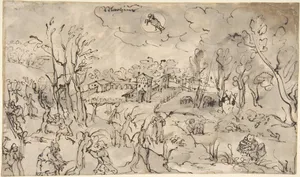
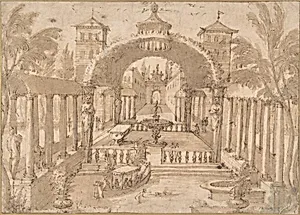
Toeput's artistic style evolved into a distinctive fusion of Netherlandish precision and Italianate grandeur, specializing in luminous landscapes featuring formal gardens, rustic arcadian scenes, banquets, and elegant music-making groups. Working primarily in Italy, he executed canvases, frescoes, and drawings that emphasized atmospheric depth, verdant foliage, and harmonious staffage, departing from the more fantastical mountainscapes of his Flemish contemporaries. His compositions often evoked the idyllic villa gardens of the Veneto region, blending detailed botanical observation with a poetic sense of leisure and nature's bounty. This approach aligned him with the emerging tradition of idealized landscape painting, distinct from the rugged terrains of the Alpine school.
Though specific dated works are sparsely detailed in surviving records, Toeput's oeuvre includes notable fresco cycles in Venetian palaces and Treviso villas, as well as portable landscapes that circulated widely. His legacy endures as a crucial link between Flemish and Italian landscape traditions; his refined, garden-centric vistas profoundly influenced the next generation of Netherlandish artists, including Joos de Momper, Tobias Verhaecht, and the van Valckenborch brothers, who adopted his balanced compositions and atmospheric effects. Settling in Treviso by 1595, Toeput continued producing until his death around 1603–1605, leaving a body of work that celebrated the serene beauty of cultivated nature and helped elevate landscape as a prestigious genre in European art. (312 words)