Ctrl K
1830–1896
Frederic Leighton, 1st Baron Leighton (1830–1896), was born on 3 December 1830 in Scarborough, England, to a prosperous medical family. His father, Dr. Frederic Septimus Leighton, and mother, Augusta Susan, provided him with financial security throughout his life, while his grandfather, Sir James Boniface Leighton, had served as physician to Russian tsars Alexander I and Nicholas I. After early education at University College School in London, the family’s extensive travels across Europe immersed young Leighton in art-rich cities like Florence and Rome. He received his formal artistic training on the continent, studying first under Eduard von Steinle at the Städelsches Kunstinstitut in Frankfurt—where he also worked with Jakob Becker of the Düsseldorf School tradition—and later at the Accademia di Belle Arti di Firenze.
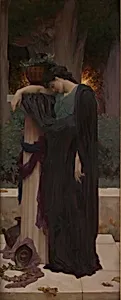
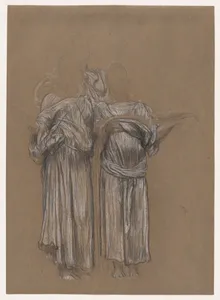
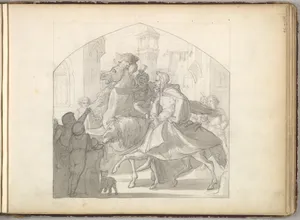
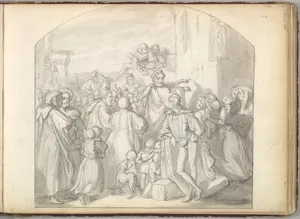
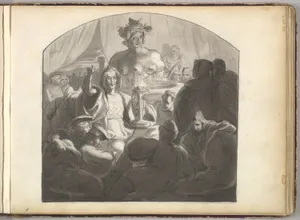
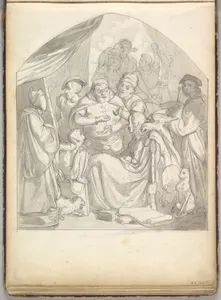
Leighton worked in the academic neoclassical tradition, favoring historical, biblical, and classical themes rendered with luminous colors, precise anatomy, and idealized beauty. His breakthrough came with *Cimabue's Celebrated Madonna Is Carried in Procession Through the Streets of Florence* (1853–1855), purchased by Queen Victoria after its debut at the Royal Academy. Elected an Associate of the RA in 1864, he became its president in 1878, shaping British art for nearly two decades. Among his major works are *The Fisherman and the Syren* (c. 1856–1858), *Actaea, the Nymph of the Shore* (1868), *Greek Girls Picking up Pebbles by the Sea* (1871), and the sculpture *An Athlete Wrestling with a Python* (1877), which sparked the New Sculpture movement’s revival of naturalistic bronze figures.
In his later years, Leighton pioneered British sculpture’s renaissance and produced masterpieces like *Captive Andromache* (c. 1888), *The Garden of the Hesperides* (c. 1892), and *Flaming June* (1895), a sensual ode to somnolent beauty that epitomized Aestheticism’s art-for-art’s-sake ethos. Knighted in 1878 and created a baronet in 1886, he achieved an unprecedented honor as the first artist elevated to the peerage as Baron Leighton on 24 January 1896—only to die of angina the next day. His Holland Park home, now Leighton House Museum with its opulent Arab Hall, preserves his legacy as a titan of Victorian art, bridging neoclassicism and emerging Symbolism while mentoring generations at the Royal Academy.