
Ctrl K
1820–1880
Louis Dodero, born Luigi Dodero on September 6, 1824, in Genoa, Italy, emerged as a pioneering figure in early photography after relocating to Marseille, France, where he worked actively from the 1840s through the 1860s. Little is known of his early training, suggesting his formative years remain sparsely documented, though his dual profession as an optician and photographer indicates a practical immersion in optical technologies during the daguerreotype era. In Marseille, he established a studio that captured the somber realities of mid-19th-century life, blending technical innovation with poignant portraiture.
Dodero's most enduring contribution came in 1851, when he proposed mounting small photographic portraits on visiting cards—a concept published in the journal *La Lumière* by Francis Wey, predating André-Adolphe-Eugène Disdéri's 1854 patent for the *carte de visite*. This format revolutionized photography, making it affordable and portable, though Disdéri reaped the commercial fame. Personally, Dodero married Victoire Marie Blanche Cassien in Marseille on November 28, 1857; she was the daughter of lithographer and photographer Victor Cassien and sister to the painter Théodore Ravanat, linking him to a creative family network.
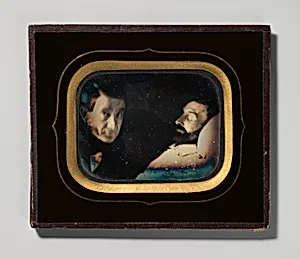
Among his surviving works, the haunting daguerreotype *Portrait of Living Man beside Dead Man* (ca. 1850) stands out, held in the Metropolitan Museum of Art's collection. This rare post-mortem image, which fetched a record 28,000 euros at auction in 2003, exemplifies Dodero's mastery of the daguerreotype process—producing finely detailed, mirror-like positives on silvered copper plates. His style favored intimate, often melancholic portraits that anticipated the democratizing force of photography.
Dodero passed away on December 18, 1902, in Six-Fours-les-Plages, France, leaving a legacy as an unsung innovator whose ideas fueled the explosion of popular photography in Europe. Though overshadowed by contemporaries, his early experiments bridged optical science and artistic expression, paving the way for the *carte de visite* mania that swept Victorian society. Today, his rarified daguerreotypes remind us of photography's origins in capturing both life's vitality and its vanities.