
Ctrl K
1833–1886
**Louis-François Devisme (1806–1879)** was a masterful Parisian gunsmith and designer whose intricate ornamentation elevated functional arms into works of art. Born in Paris on July 9, 1806, the son of a gunsmith from Versailles, Devisme's early life and formal training remain sparsely documented, though his craft clearly stemmed from familial traditions in arme blanche and firearms production. By 1834, he had established his renowned workshop at 36 Boulevard des Italiens, where he quickly gained acclaim for blending technical innovation with lavish decoration, earning an Honorable Mention at the 1834 Paris Exhibition and subsequent silver medals.
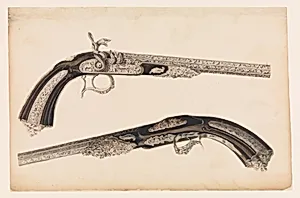
Devisme's artistic style drew from Renaissance revival, neoclassical, and Second Empire aesthetics, featuring etched floral motifs, chiseled gold inlays, and Fabergé-like opulence on swords, pistols, and revolvers. His workshop produced an album of thirty-five original drawings for sword and firearm ornaments around 1850–1860, now in the Metropolitan Museum of Art, showcasing eclectic designs from hilts to triggers. Key innovations included the 1854-patented six-shot percussion revolver with an internal hammer and unique "tige" loading system inspired by French military adaptations, later evolving into the 1858/59 cartridge model. Other masterpieces encompass a musket case at the Walters Art Museum (ca. 1850–1875), opulent hunting daggers, and presentation swords, such as an ivory-gripped piece for Confederate General Robert E. Lee in 1863.
Devisme's legacy endures as a pinnacle of 19th-century French arms artistry, with products coveted by European royalty, military leaders, and even American Civil War figures like Generals Jeb Stuart and Jefferson Davis. Honored as a Knight of the Legion of Honor, Commander of Russia's Order of Saint Anne, and Officer of Portugal's Order of the Conception, his firm supplied global elites until his death on April 29, 1879, in Argenteuil, after which it declined following his son Jean Baptiste's passing. Today, Devisme's creations—prized for their mechanical ingenuity and sculptural beauty—stand as testaments to the fusion of utility and high art in decorative arms design.