
Ctrl K
1894–1994
Louis H.S. Calewaert (1894–ca. 1994) was an American artist renowned for his meticulous etchings that captured intimate portraits, urban scenes, and evocative landscapes. Born in Detroit, Michigan, his early life remains sparsely documented, though he received formal training at the Detroit School of Fine Arts, where he earned a strong reputation as a student. Records indicate he also studied with Wicker—likely referring to John Palmer Wicker, a prominent figure in Detroit's art education scene—and pursued further instruction in Italy and Sicily, broadening his technical and observational skills in printmaking and beyond.
Calewaert relocated to Chicago, Illinois, where he established himself as a professional painter, etcher, and sculptor, actively participating in the local art community. He exhibited with the Chicago Society of Etchers, contributing to shows that traveled to institutions like the Detroit Institute of Arts. His style aligned with the realist traditions of early 20th-century American printmaking, emphasizing fine line work, atmospheric depth, and everyday subjects rendered with precision and emotional resonance. Travels to Europe influenced later works, infusing his oeuvre with continental motifs amid his Midwestern roots.
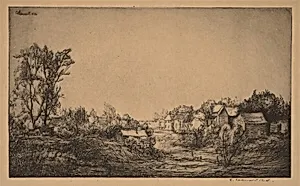
Among his notable etchings are early pieces like *The Detroit River* (1913), a nostalgic view of his hometown; *Grandmother in Chair* (1914), a tender portrait of his grandmother, Madame Philippine Brun; and *The Hollow* (1914), showcasing his command of shadow and texture. Later prints include *Ex-Libris: Nov. 1910*, *Le Bateau-Lavoir (The Washerwoman's Boat)* (c. 1925), evoking Parisian river life, and *Poggio Mirteto* (1933), a detailed Italian landscape with figures amid orchards and farms.
Though not a household name, Calewaert's prints endure in prestigious collections, including the National Gallery of Art, Smithsonian American Art Museum, Library of Congress, and Minneapolis Institute of Art, affirming his quiet legacy as a skilled technician whose works preserve fleeting moments with enduring clarity. His commitment to etching during a modernist era underscores the value of traditional craft in American art history.