Ctrl K
1892–1973
Louis Lozowick was born in 1892 in Liudvynivka, in the Kiev Governorate of the Russian Empire (now Ukraine), into a Jewish family. He received his earliest artistic training at the Kiev Art School before emigrating to the United States, where he continued his studies at the National Academy of Design in New York from 1912 to 1915 and subsequently earned a degree from Ohio State University in 1918. But it was Europe, not the American academy, that truly transformed his vision.
Between 1919 and 1924, Lozowick lived and traveled extensively across Paris, Berlin, and Moscow, absorbing the radical currents of the international avant-garde. In Berlin he developed a close friendship with the Russian Constructivist El Lissitzky, whose machine aesthetic and geometric clarity profoundly influenced Lozowick's emerging style. In Moscow he briefly encountered Kazimir Malevich and Vladimir Tatlin. These encounters crystallized his conviction that art could celebrate the rational beauty of industrial modernity — the skyscraper, the bridge, the factory — without sentiment or nostalgia.
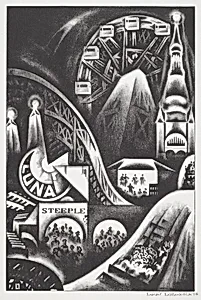
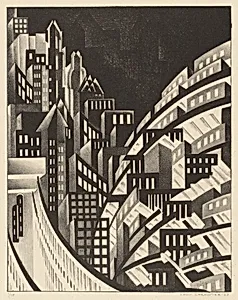
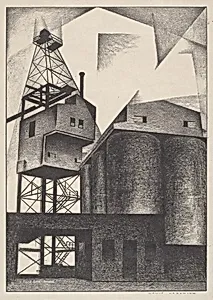
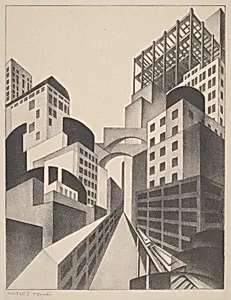
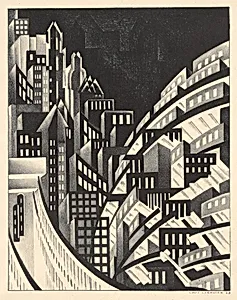
Back in the United States, Lozowick became a leading figure in American Precisionism and Art Deco printmaking, producing streamlined, monochromatic lithographs of urban subjects with a formal rigor that owed as much to Constructivism as to American optimism. Works such as Pittsburgh (1922–1923) and New York (c. 1925–1926) render the industrial cityscape as an almost abstract composition of geometric volumes. His first solo exhibition of lithographs was held at the Weyhe Gallery in 1929. During the 1930s he worked under the WPA Federal Art Project and painted murals for the New York City General Post Office. He also published the important monograph Modern Russian Art, helping to introduce Constructivist ideas to American audiences. Lozowick died in 1973 in South Orange, New Jersey.
All 6 artworks loaded