Ctrl K
1741–1814
Louis Michel Halbou was born in Paris in 1730 and became one of the accomplished French draughtsmen and engravers of the later eighteenth century. He studied under Nicolas-Gabriel Dupuis, the distinguished engraver to the king and member of the Académie, remaining in a lengthy apprenticeship that allowed his technique to mature by around 1760. Specializing in the burin, Halbou finished many etchings begun by others and occasionally designed his own vignettes. He worked almost exclusively in Paris, active from 1763 to 1800, and lived on the Left Bank near the printsellers’ quarter, first on the rue de la Comédie-Française and later on the rue des Rats.
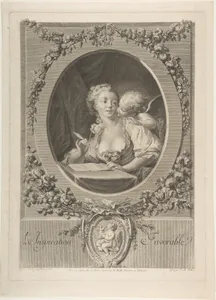
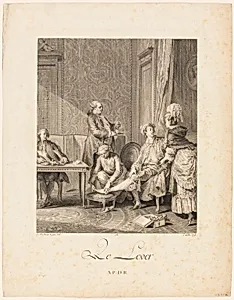
Halbou’s art belongs to the pre-Romantic generation of French printmaking, bridging the elegant Rococo of the mid-century with a more intimate, morally inflected genre style. He excelled at translating paintings into finely detailed copper engravings, capturing both courtly grace and everyday sentiment. His prints after Jean-Michel Moreau le Jeune, Jean-Honoré Fragonard, and Johann Eleazar Schenau were especially successful, often sold through the shop of the Veuve Chéreau. He also produced numerous book illustrations, contributing plates to Goury de Champgrand’s Traité de vénerie (1769), the Cabinet Basan (1771), and later collective publications such as the Musée français.
Among his notable works is the 1770 engraving La Crédulité sans réflexion, after Schenau and dedicated to the Prince of Condé, a characteristic moral scene that showcases his precise line and narrative clarity. He likewise engraved after Old Masters such as Adriaen van der Werff (Mary Magdalene in the Desert) and contributed to deluxe illustrated editions that circulated widely among collectors. A receipt from 1792 records a substantial payment of 1,600 livres for one such plate, evidence of his professional standing. His students included Nicolas-Auguste Leisnier, extending his influence into the next generation of French engravers.
Halbou died in Paris in 1809. Although biographical details remain limited, his prolific output of prints survives in major public collections, including the Edmond de Rothschild holdings at the Louvre, the Musée du château de Versailles, the Art Institute of Chicago, the British Museum, and the Wellcome Collection. These works continue to illustrate the refinement and narrative richness of late-eighteenth-century French graphic art, preserving the visual culture of the Ancien Régime for later audiences.