
Ctrl K
1806–1847
Ludwig Friedrich Deurer (1806–1847) was a German history painter whose brief career bridged Romanticism and the Nazarene movement, blending meticulous draftsmanship with historical and genre subjects. Born in Mannheim on July 16, 1806, he was the son of the esteemed painter and gallery inspector Peter Ferdinand Deurer and Susette Fröhlich. After completing his studies at the gymnasium, Deurer trained as a genre painter in Nuremberg under Klein before shifting to historical painting in Munich, where he studied under the leading Nazarenes Peter von Cornelius and Julius Schnorr von Carolsfeld. These mentors instilled in him a reverence for Raphael and the old masters, emphasizing clarity, idealism, and spiritual depth in composition. His father, who had relocated to Rome to study Raphael's techniques, brought the young artist there twice, fostering Deurer's exposure to Italian landscapes and classical antiquity.
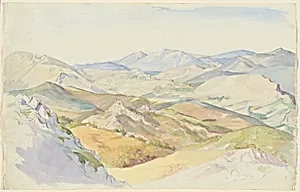
Deurer worked in the Nazarene school tradition, producing genre scenes and romantic landscapes that captured dramatic narratives and natural beauty with precise watercolor and oil techniques. Among his major works, *Crusaders before Jerusalem*—painted during his Roman sojourns—stands out as his most celebrated piece, acquired by the Grand Duke of Baden and awarded a gold medal at the Karlsruhe exhibition. Other notable creations include the watercolor *The Sabine Hills and Rocca Santo Stefano Seen from Civitella* (1835), a luminous study of Italian terrain now in the National Gallery of Art, and *The Turkish Rider* (1842), an elegant equestrian portrait evoking Orientalist exoticism. Financial pressures led him to assume the role of post stable master in Mannheim in 1836, supporting a relative, though he persisted with sketches and studies. In 1844, he returned to Rome to settle his father's estate, producing nature studies amid legal duties before falling ill with scarlet fever upon his 1845 homecoming.
Deurer's legacy endures through his influence on family—his daughter Maria (b. 1846) married the painter Eugen Bracht—and a modest oeuvre preserved in major collections like Karlsruhe and Mannheim. Scholarly works, such as Sabina Wagner's 1999 monograph, highlight his Romantic landscape drawings, affirming his place as a Mannheim artist whose Nazarene rigor and Italianate visions bridged northern precision with southern splendor. Tragically cut short at 41, Deurer's output reflects the era's tension between artistic aspiration and practical necessity.
All 1 artworks loaded