Ctrl K
1832–1903
Ludwig Johann Passini, born on July 9, 1832, in Vienna, emerged as one of the 19th century's premier genre painters and virtuoso watercolorists, capturing the vibrant everyday life of Italy with exquisite detail and narrative depth. The son of engraver Johann Nepomuk Passini, he received his initial artistic training from his father, developing early proficiency in watercolor and sketching amid Vienna's Biedermeier and Realist circles. Passini then studied at the Vienna Academy of Fine Arts under Joseph von Führich and Leopold Kupelwieser starting in 1847, before relocating to Leipzig to work under Carl Werner, accompanying the master watercolorist on an extensive painting tour of Italy. In the 1850s, he joined Werner's studio in Venice, honing his craft amid the city's luminous canals and architectural splendor.
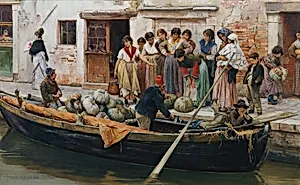
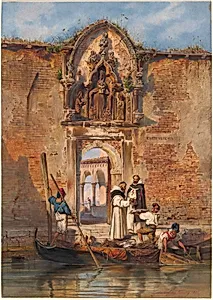
Passini's style blended narrative genre scenes with meticulous architectural backdrops, favoring watercolors that evoked the atmospheric intimacy of Roman and Venetian life—figures in confessional booths, bustling fish markets, and ecclesiastical interiors rendered with fluid wet-on-wet techniques and precise detailing. Key works include *Monks Buying Fish before the Portal of the Madonna della Misericordia* (1855), *Caffè Greco in Rome* (1856, now in Kunsthalle Hamburg), *The Confessional* (1863), *The Latin Class* (1869), and *Praying in a Venetian Church* (1873). After marrying Anna Warschauer in 1864—whose untimely death in 1866 left him with a daughter—he alternated between Rome, Berlin, and Venice, producing evocative oils and prints that earned medals at Paris (1870), Vienna (1873), and Munich (1879).
Settling permanently in Venice from 1873, Passini occupied a studio in the Palazzo Vendramin Calergi alongside fellow artists, immersing himself in the city's decaying elegance and painting portraits for luminaries like Isabella Stewart Gardner and Katherine Bronson in 1892. A friend of Richard Wagner, he helped create the composer's death mask in 1883. His legacy endures as "the major watercolor painter of Venice," lauded by critics like Wilhelm Lübke for masterful Southern character studies; he advised on the inaugural Venice Biennale (1893), received the Bavarian Maximilian Order, and became an honorary professor of the Vienna Academy. Passini's works, blending technical brilliance with poignant humanism, continue to chronicle Italy's soul for modern audiences.