Ctrl K
Lynn Russell Chadwick (1914–2003) was a pioneering British sculptor whose innovative use of metal transformed postwar sculpture. Born in the London suburb of Barnes, he attended Merchant Taylors' School in Northwood, where an art master steered him toward architecture rather than fine art. Chadwick trained as an architectural draughtsman in the offices of Donald Hamilton, Eugen Carl Kauffman, and notably Rodney Thomas, whose interest in contemporary European design profoundly influenced his early compositional skills—this remained his only formal artistic education, as he was entirely self-taught as a sculptor. During World War II, as a conscientious objector turned volunteer pilot in the Fleet Air Arm, he honed technical precision escorting Atlantic convoys. Postwar, he freelanced on exhibition stands, winning a textile design prize in 1946 that led to commissions. By 1947, inspired by Thomas, he crafted his first delicate mobiles from wire, balsa, copper, and brass—fish-like forms that evolved into grounded "stabiles." His debut solo exhibition at Gimpel's in 1950 marked his sculptural breakthrough.
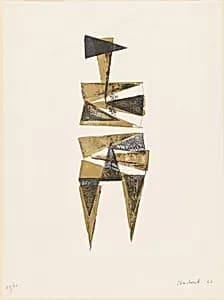
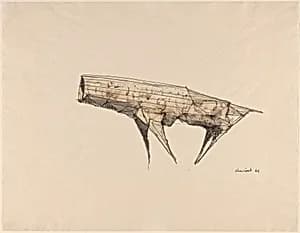
Chadwick's style aligned with the "Geometry of Fear" group—alongside Kenneth Armitage, Reg Butler, and others—characterized by angular, semi-abstract bronzes and steel frameworks evoking postwar anxiety, defiance, and stark monumentality. He pioneered welded steel armatures for expressive, insectoid figures and later humanoid pairs, using "stolit" (gypsum-iron mix) for textured models cast in bronze. Early triumphs included *The Fisheater* (1951, Tate) and *Green Finger* (1951, Battersea Park), while his 1956 International Sculpture Prize at the Venice Biennale—surpassing Giacometti—catapulted him to global fame, with touring shows across Europe. Iconic works like *The Watchers* (1960), *Two Winged Figures* (1962), and the faceted *Elektra* series captured vigilant, cloaked sentinels amid Cold War shadows.
In 1959, Chadwick settled at Lypiatt Park, Gloucestershire, converting it into a studio-foundry and sculpture park. His oeuvre expanded to Easter Island-inspired abstractions like *King* (1964), seated couples (*Couple on Seat*, 1984), and late stainless-steel "beasts" such as *Rising Beast* (1989) and *Howling Beast I* (1990), their reflective facets animating space. Awards included CBE (1964), Commandeur des Arts et des Lettres (1993), and Royal Academician status. Retrospectives at Yorkshire Sculpture Park (1992) and Tate Britain (2003) affirmed his legacy; his works grace MoMA, Tate, Pompidou, and beyond, embodying a vital, angular response to human form and modernity.
All 3 artworks loaded