Ctrl K
1526–1600
Mahmud 'Abd-al Baqi, also known as Bâkî (1526–1600), was a celebrated Ottoman poet and judge whose legacy intertwines with the vibrant world of 16th-century Istanbul court life. Born into a modest family—his father served as muezzin at the Fatih Mosque—he initially apprenticed as a harness-maker before pursuing formal education at a medrese, where he absorbed lectures from prominent scholars and drew poetic inspiration from the established master Zâtî. Rising through the Ottoman bureaucracy, he became a kadı and enjoyed favor at the palaces of Süleyman I, Selim II, and Murad III. Little is known of any artistic training, as his documented career centered on jurisprudence and verse rather than painting.
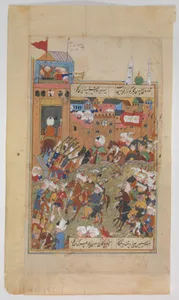
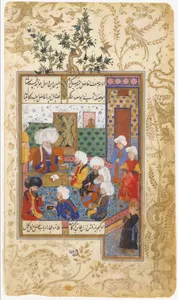
Baqi's most enduring contribution to visual art lies in the lavish illustrations adorning manuscripts of his *Divan*, a collection of poems capturing the opulence, pleasures, and events of Ottoman elite society. Four known illustrated copies exist, featuring miniatures in the Ottoman Turkish style, characterized by dynamic compositions, vibrant opaque watercolors, gold accents, and meticulous depictions of architecture, figures, and landscapes. Notable examples include "The Great Abu Sa'ud Teaching Law" (mid-16th century), portraying the Shaikh al-Islam Abu al-Sa'ud amid theological discourse to accompany a laudatory qasida, attributed to a Baghdad workshop. Another is "Ottoman Army Entering a City" (last quarter 16th century), illustrating Safavid prince Haidar Mirza's arrival as a hostage, brimming with bustling crowds, ornate gates, and military pomp in a quintessentially Turkish manner.
These folios reflect the Baghdad school's influence under Ottoman patronage, blending narrative vigor with courtly splendor, though specific painters remain unattributed. Baqi's *Divan* miniatures exemplify the classical Ottoman miniature tradition, bridging poetry and image to immortalize imperial triumphs and intellectual pursuits. Dubbed "Sultan of Poets," his work endures as a window into the empire's golden age, with the illustrated pages cherished in collections like the Metropolitan Museum of Art for their historical and aesthetic richness.