Ctrl K
1887–1985
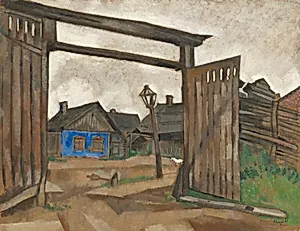
Marc Chagall, born Moishe Shagal on July 7, 1887, in Liozna near Vitebsk in the Russian Empire (now Belarus), grew up as the eldest of nine children in a devout Jewish family confined to the Pale of Settlement. His father worked as a herring merchant's porter, while his mother sold groceries from home, instilling in young Chagall a deep connection to Hasidic Judaism and Eastern European folklore amid experiences of antisemitism. He began formal art training at age 19 in 1906 under Yehuda Pen at Pen's private drawing school in Vitebsk, where Pen taught him free of charge. Moving to Saint Petersburg, Chagall studied from 1908 to 1910 under Léon Bakst at the Zvantseva School of Drawing and Painting, absorbing influences from Bakst's work with the Ballets Russes. In 1910, he arrived in Paris, enrolling at the avant-garde Académie de La Palette, where instructors included Jean Metzinger and Henri Le Fauconnier, and frequented the Louvre amid the city's modernist ferment.
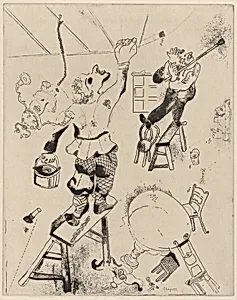
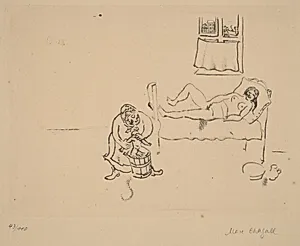
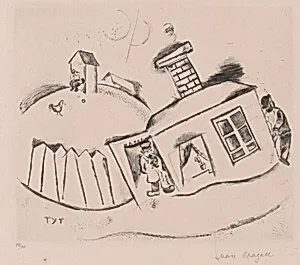
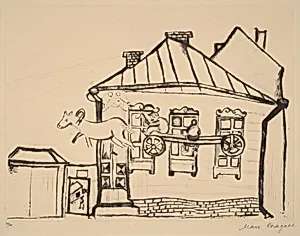
Chagall emerged as an early modernist associated with the École de Paris, forging a singular style that synthesized Fauvism's vibrant colors, Cubism's fragmentation, Symbolism's mysticism, and proto-Surrealist dream logic. His paintings evoke the reverie of Vitebsk life through floating figures, hybrid animals, fiddlers on roofs, and lovers defying gravity, rooted in Jewish folklore, Yiddish tales, and Kabbalistic motifs—creating what Pablo Picasso called a unique mastery of color. In 1915, he married Bella Rosenfeld, his lifelong muse who appeared in works like *Birthday* (1915–1923), and they had daughter Ida before settling briefly in Vitebsk, where Chagall founded an avant-garde art school.
Among his major works, *I and the Village* (1911–1912) captures inverted village scenes at the Museum of Modern Art; *The Fiddler* (1912) inspired the musical *Fiddler on the Roof*; and *Paris Through the Window* (1913) blends Eiffel Tower views with dreamlike whimsy. Later masterpieces include 105 etchings for *The Bible* (1931–1956), the Paris Opera ceiling (1963–1964) honoring composers, and the UN's *Peace* stained-glass window (1964). Chagall's legacy endures as the pre-eminent 20th-century Jewish artist and last survivor of Europe's first modernists, his murals, stained-glass windows in cathedrals worldwide (like Zürich's Fraumünster in 1967), and ballet designs influencing Surrealism while chronicling a century of upheaval—from pogroms to the Holocaust—until his death in 1985.