
Ctrl K
**Claude-Joseph Vernet** (1714–1789) was a leading French painter of the eighteenth century, renowned for his masterful marine and landscape scenes. Born in Avignon on 14 August 1714, he received his initial training from his father, Antoine Vernet, before studying with the history painter Philippe Sauvan. He later traveled to Italy, where he spent many years honing his skills in Rome and other centers, absorbing influences from the classical landscape tradition while developing his distinctive approach to seascapes and atmospheric effects.
Vernet worked primarily in the French landscape and marine painting tradition, excelling at both serene Italianate views and dramatic depictions of storms and tempests. His most celebrated achievement was the ambitious “Ports of France” series, commissioned by Louis XV, which documented the nation’s major harbors with remarkable topographical accuracy and luminous detail. Other notable works include numerous moonlight scenes, shipwrecks, and coastal landscapes that captured the sublime power of nature. He was admitted to the Royal Academy in 1753 and enjoyed widespread patronage from European courts and collectors.
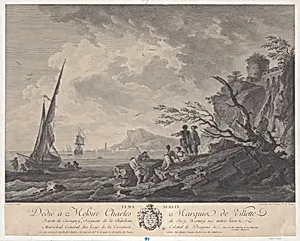
A member of a prominent artistic family, Vernet’s son Carle Vernet and daughter Marguerite Émilie Chalgrin both became painters. His legacy endures as one of the foremost marine artists of his era, alongside Hubert Robert, influencing generations with his ability to blend precise observation and poetic atmosphere. The single work in the collection—an engraving by the eighteenth-century French printmaker Maria Fr. Ozanne after one of Vernet’s compositions—exemplifies how his imagery was widely disseminated through prints, extending his reach well beyond the original paintings. Vernet died in Paris on 3 December 1789.