Ctrl K
1841–1916
Marie Anne Caroline Bracquemond (née Quivoron) was born on 1 December 1840 in Argenton-en-Landunvez, Brittany, and became one of the four notable women of French Impressionism, alongside Mary Cassatt, Berthe Morisot, and Eva Gonzalès. She studied drawing as a child and, at age 17, began painting lessons under Auguste Vassor, a restorer who taught young women in Étampes. Her rapid progress led to a painting of her mother, sister, and teacher being accepted at the Paris Salon in 1857. She then received limited instruction from Jean-Auguste-Dominique Ingres, who introduced her to his students Hippolyte Flandrin and Émile Signol; critic Philippe Burty later called her one of the most intelligent pupils in Ingres’s studio. She never attended a formal academy, instead supporting herself as a copyist at the Louvre and a drawing teacher.
While copying Old Masters at the Louvre she met the printmaker Félix Bracquemond; they married in 1869 and had one son, Pierre. Together they designed ceramics for Haviland & Co., including her monumental tile panel *Les Muses des arts* shown at the 1878 Universal Exhibition. Bracquemond exhibited at the official Salon from 1864 and joined the Impressionist group shows of 1879, 1880, and 1886. Under the influence of Claude Monet, Edgar Degas, and especially Paul Gauguin—who taught her to prepare canvases for more intense color—her style evolved from Ingres-inspired academic Realism toward luminous plein-air painting. She worked in the Impressionist tradition, favoring outdoor scenes, modern life, and the play of light, often using her sister Louise and her garden at Sèvres as subjects.
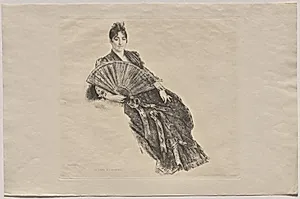
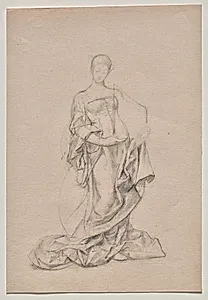
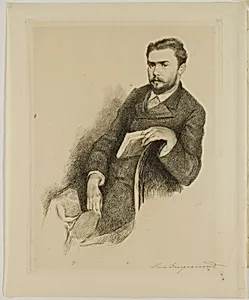
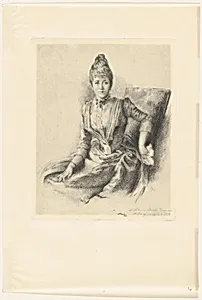
Among her most celebrated paintings are *The Lady in White* (1880), *On the Terrace at Sèvres* (1880), *Afternoon Tea* (1880), and *Under the Lamp* (1887). These works display her distinctive blend of careful preparatory drawing with broken brushwork, cropped compositions, and a brightening palette that captured sunlight on white dresses and garden foliage. She also produced etchings, watercolors, and ceramic designs, demonstrating remarkable versatility across media.
Félix, who disliked Impressionism, grew jealous of her talent, belittled her ambitions, and refused to show her pictures to visitors; worn down by household friction, she largely abandoned public painting after 1890, though she remained a passionate defender of the movement. She died in Sèvres on 17 January 1916. Long overshadowed, she was hailed by Henri Focillon in 1928 as one of “les trois grandes dames” of Impressionism. Feminist scholarship and recent exhibitions have restored her reputation, revealing an artist whose intimate, sunlit scenes rank among the movement’s most original contributions. Her works now reside in major collections including the Musée d’Orsay and the Petit Palais.