
Ctrl K
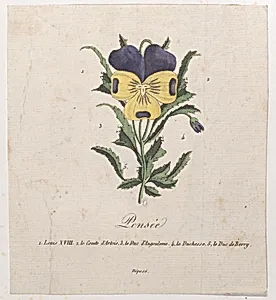
**Marie-Caroline de Bourbon-Sicile, Duchess of Berry (1798–1870)** was an Italian-born princess of the House of Bourbon-Two Sicilies who became a prominent figure in French royal circles through marriage and later distinguished herself as an influential patron and collector of the arts.
Born Maria Carolina Ferdinanda Luisa at Caserta Palace near Naples on 5 November 1798, she was the eldest child of the future King Francis I of the Two Sicilies and Archduchess Maria Clementina of Austria. In 1816 she married Prince Charles Ferdinand, Duke of Berry, son of the future Charles X of France, in an arranged union that proved happy; the couple resided at the Élysée Palace in Paris. Following her husband’s assassination in 1820, she gave birth to their son Henri, Count of Chambord—the “miracle child” who preserved the direct Bourbon line—and emerged as a key political and cultural figure during the Bourbon Restoration.
Although no records indicate formal artistic training or that she produced paintings herself, the Duchess was an enthusiastic collector and patron whose tastes shaped early nineteenth-century French artistic circles. She and her husband assembled a notable collection featuring landscapes by Jacob van Ruisdael, genre scenes by Auguste-Xavier Leprince, and works by artists including Jan van der Heyden, François Marius Granet, Pauline Auzou, and Hortense Haudebourt-Lescot. Her 1822 sale catalogue, illustrated with pioneering lithographs by Isidore Laurent Deroy, helped popularize the new reproductive technique. She also supported the Sèvres Porcelain Manufactory and the Théâtre du Gymnase (temporarily renamed the théâtre de Madame in her honor), commissioning and attending performances that blended royal prestige with contemporary culture.
After the July Revolution of 1830 and her unsuccessful 1832 Vendée uprising in support of her son’s claim, Marie-Caroline lived in exile, remarried Italian nobleman Ettore Lucchesi-Palli in 1831, and eventually settled in Austria. Her legacy endures through her role in preserving Bourbon cultural traditions and through the dispersal of her distinguished art collection, which reflected the refined tastes of the Restoration era. She died at Brunnsee, Styria, on 16 April 1870.