Ctrl K
1855
Marjorie McIntyre was an American artist active around 1935 whose precise documentary watercolors form a small but distinctive part of the nation’s visual record of historic dress and textiles. Little is known of her early life or formal training, yet her surviving works place her firmly among the hundreds of artists employed by the Index of American Design, a Federal Art Project of the Works Progress Administration. Between 1935 and 1942 this ambitious New Deal program commissioned accurate watercolor renderings of American decorative arts, folk crafts, and costumes so that a uniquely national aesthetic heritage would not be lost.
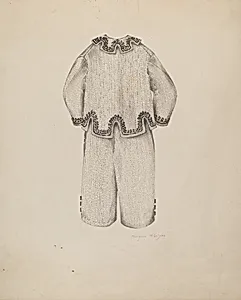
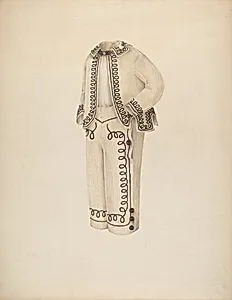
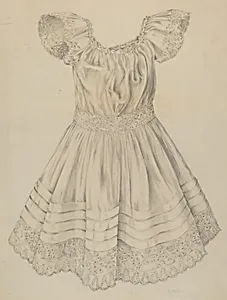
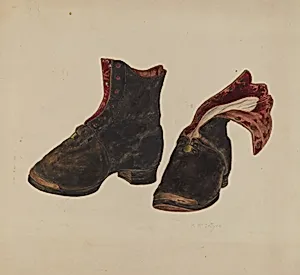
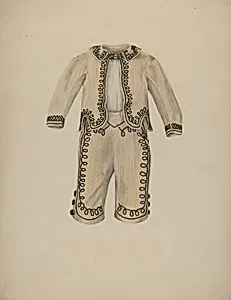
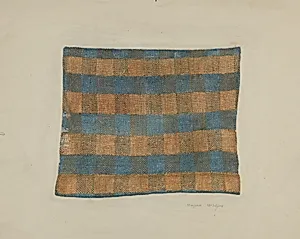
McIntyre specialized in children’s clothing and household textiles, working in watercolor, graphite, gouache, and occasional colored pencil on paper or paperboard. Her six known plates—three versions of a Boy’s Suit (c. 1938 and 1935/1942), a Child’s Dress (1935/1942), a pair of Boy’s Shoes (1935/1942), and a study of Homespun Linen (1938)—demonstrate the Index’s exacting standards: every seam, button, weave, and fold is recorded with scientific clarity and quiet elegance. These images capture the modest yet carefully constructed garments of earlier American childhood, from fitted jackets and knee-length trousers to simple linen weaves, preserving details that photographs of the period often missed.
The resulting plates are both historical documents and works of art. McIntyre’s controlled washes and fine graphite lines convey the weight of fabric and the play of light across embroidered or homespun surfaces, transforming utilitarian objects into objects of contemplation. Today all six reside in the National Gallery of Art’s Index of American Design collection, a corpus of more than 18,000 watercolors that remains an indispensable resource for costume historians, designers, and anyone seeking to understand the material culture of pre-industrial America. Through her modest yet meticulous contribution, McIntyre helped ensure that the everyday artistry of American childhood dress would continue to be seen and studied.