
Ctrl K
1704–1759
Martin Tyroff (1704–1759) was a prominent German engraver and publisher active in Nuremberg, born on November 19, 1704, as the son of Johann Georg Jacob Tyroff.) Little is known of his early life or formal training, which remains sparsely documented, though he established himself as a skilled draughtsman and copper engraver (Zeichner und Kupferstecher) in the vibrant artistic hub of Nuremberg. In 1729, Tyroff married Barbara Sybilla Weigel (1699–1738), daughter of the renowned publisher Christoph Weigel the Elder and widow of painter Johann Kenkel; this union brought him control of the esteemed Weigel art dealership and publishing house, which he managed until his death.) He remarried in 1740 to Maria Magdalena Gelly, daughter of an Erlangen merchant.)
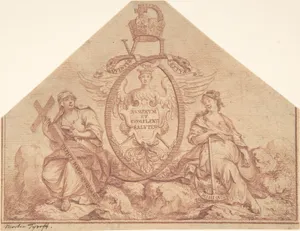
Tyroff worked in the robust tradition of Nuremberg's copper engraving school, producing intricate prints that blended Baroque ornamentation with precise technical mastery, often focusing on heraldry, portraits, and biblical scenes. Among his notable contributions were engravings for Johann Jakob Scheuchzer's *Physica Sacra* (1731–1735), collaborating with artists like Georg Wolfgang Knorr and Hieronymus Sperling; a depiction of St. Gregory's Mass after the Holzschuher family burial carpet (c. 1755); and the coronation procession of Maria Theresa.,_Hieronymus_Sperling_(1695-1777),_Catherine_Sperling_(1699-1741).jpg) He also created portraits of Martin Luther, Maria Theresa, and Emperor Franz I, as well as frontispieces like *Design for a Frontispiece with Figures of Faith and Hope*, and worked after masters such as Johann Justin Preisler and Jean Étienne Liotard.) His output extended to book illustrations, ex-libris, and heraldic plates, reflecting Nuremberg's legacy in scientific and religious publishing.
Tyroff's legacy endures through his family dynasty of engravers. His sons—Johann David Tyroff (1733–1770) from his first marriage and Hermann Jakob Tyroff (1742–1786) from his second—continued the trade, with Hermann Jakob founding the *Tyroff’schen adeligen Wappenwerkes*, a renowned series of 71 noble coat-of-arms plates. Grandchildren like Konrad Tyroff (1771–1826) perpetuated the heraldic tradition until the line faded with great-grandson Johann Andreas Tyroff in 1872.) By sustaining and expanding the Weigel firm, Tyroff bridged Baroque engraving into the Enlightenment era, preserving Nuremberg's status as a center for fine printmaking and contributing enduring visual records of history and faith.
All 1 artworks loaded