Ctrl K
Master F.P., also known as Master FP, was an anonymous Italian printmaker active in the first half of the 16th century, roughly between 1527 and 1540. His career coincided closely with that of the celebrated Mannerist painter Parmigianino (Francesco Mazzola, 1503–1540), and he is renowned for producing around 26 etchings faithfully reproducing Parmigianino's designs, some signed simply "F.P."—a monogram that may have been intended to evoke the master himself, further obscuring the etcher's true identity. Little is known of Master F.P.'s early life or training, which remains undocumented in surviving sources; he emerges primarily through his technical prowess in etching, a novel medium at the time that Parmigianino himself pioneered.
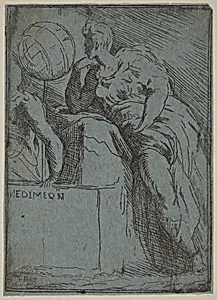
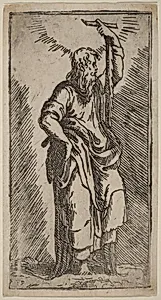
Master F.P. likely worked in close proximity to Parmigianino during the artist's sojourn in Bologna from 1527 to 1530, following the Sack of Rome, translating the painter's fluid drawings into prints that epitomized Mannerist elegance—elongated figures, dynamic poses, and a sense of ethereal grace. His etchings adhered to the Paramese master's school tradition, capturing mythological and religious themes with delicate linework on laid paper, sometimes tinged blue for dramatic effect. Among his most notable works are *Endymion*, depicting the slumbering shepherd from classical mythology (National Gallery of Art), and *Fortitude*, a personification of virtue (Metropolitan Museum of Art). He also produced a complete series on *Christ and the Twelve Apostles*, including *Saint Simon*, *Saint Thomas*, *Saint Andrew*, *Saint James Major*, and *Saint John the Evangelist*, as well as mythological scenes like *The Centaur Nessus Abducting Dejanira with Hercules*, *Hercules and Cerberus*, and *Astrology* (British Museum).
Though his personal legacy is elusive due to anonymity, Master F.P. played a crucial role in the diffusion of Parmigianino's innovative style across Europe via affordable prints, bridging painting and reproductive engraving in the dawn of Mannerist printmaking. His contributions amplified Parmigianino's influence, paving the way for later etchers like Andrea Schiavone, and his works remain prized in major collections for their fidelity and refinement. Today, they offer a window into the collaborative spirit of Renaissance workshops, where technique met genius.
All 2 artworks loaded