Ctrl K
1450–1500
**Master i.e.**, a pseudonym derived from the Gothic initials "i.e."—possibly his monogram—appearing in reverse on a rare engraving of a peasant holding a sausage, was a prolific German engraver active between approximately 1480 and 1500. Little is documented about his personal life, which remains shrouded in the anonymity typical of many late medieval printmakers, but his oeuvre reveals a masterful command of the burin, producing intricate religious images that circulated widely across Europe.
Master i.e. most likely worked in the shop of the renowned engraver Martin Schongauer, whose influence permeates his 55 attributed prints catalogued by Max Lehrs, including 31 direct copies of Schongauer's designs. This close association placed him firmly within the Swabian-German engraving tradition of the late Gothic period, characterized by fine, swelling lines, elaborate drapery patterns, and expressive figures set against minimal backgrounds. His style expanded on Schongauer's by emphasizing graceful, pensive saints with detailed brocade robes and braided hair, as seen in his elegant single-figure compositions that prioritized devotional intimacy over narrative complexity.
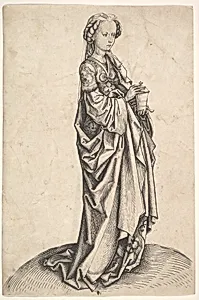
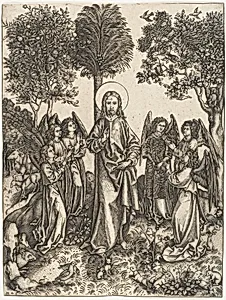
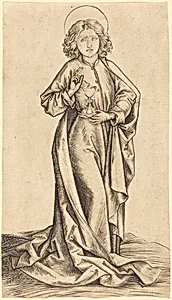
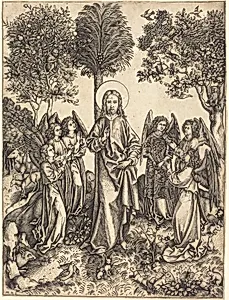
Among his major works are *Mary Magdalen* (ca. 1490, Metropolitan Museum of Art), depicting the saint clutching an ointment jar atop a schematic mound; *Christ in the Wilderness Served by Angels* (ca. 1480–90, Metropolitan Museum of Art and National Gallery of Art); *Saint John the Evangelist* (ca. 1480/1490, National Gallery of Art); *Saint Elizabeth of Hungary* (late 15th century, Birmingham Museum of Art); and *The Baptism of Christ* (ca. 1480–1500, Clark Art Institute). These engravings, often in multiple states, showcase his technical prowess in rendering textures—from flowing hair to metallic halos—and his focus on popular saints, making sacred imagery accessible to a broader audience through affordable prints.
Though his identity eludes us, Master i.e.'s legacy endures as a key figure in the diffusion of Schongauer's innovations, bridging the master's generation to early Renaissance engravers like Albrecht Dürer. His copies preserved and popularized Gothic devotional motifs, contributing to the explosive growth of printmaking in Northern Europe and influencing subsequent anonymous masters such as Master BM and Master AG. Today, his works grace major collections, offering a window into the vibrant workshop culture of 15th-century Germany.