Ctrl K
1400–1429
**Master of 1416** (active early 15th century in Florence; c. 1400–1429) is the notname given to an anonymous Italian painter whose identity remains tied to a dated altarpiece of 1416. Working in the late Gothic Florentine tradition, he produced both devotional panels and secular objects during the transition toward early Renaissance styles. His output reflects the elegant, decorative manner of the period, with graceful figures, rich colors, and narrative clarity suited to both religious and domestic settings.
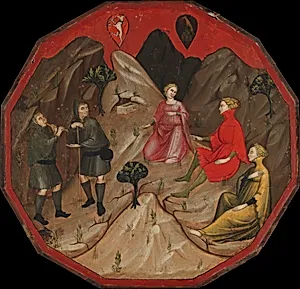
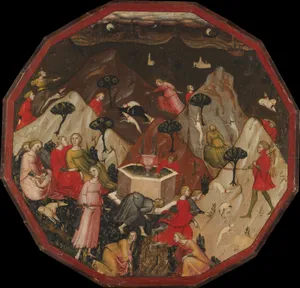
The artist takes his name from a signed altarpiece dated 1416 showing the *Madonna and Child with Saints John the Baptist, Anthony Abbot, Julian, and Peter*, now in the Galleria dell’Accademia, Florence. A substantial group of works has been attributed to him on stylistic grounds, including small devotional images and more ambitious secular pieces. His most celebrated surviving work is the pair of painted birth trays (*deschi da parto*) illustrating episodes from Giovanni Boccaccio’s *Comedia delle ninfe fiorentine*. One panel, *Ameto’s Discovery of the Nymphs* (c. 1410), and its companion depicting a musical contest between shepherds, are now in the Metropolitan Museum of Art. These twelve-sided tempera panels, originally the front and back of a single tray, combine lively storytelling with the refined courtly aesthetic of early fifteenth-century Florence.
Scholars have noted the master’s close affinity with the late Gothic painter Lorenzo di Niccolò and have proposed that the body of work associated with the Master of 1416 may represent the collaborative output of a workshop shared by Lorenzo’s relatives, Bartolomeo di Piero and Piero di Lorenzo. While the precise identity of the painter remains uncertain, the surviving paintings demonstrate a consistent hand skilled in both sacred iconography and secular narrative.
The Master of 1416 occupies a modest but instructive place in Florentine art history. His documented activity around 1410–1416 bridges the International Gothic style and the emerging naturalism of the Renaissance. The two panels in the Metropolitan Museum remain the most accessible examples of his secular production, offering insight into the domestic art and literary culture of early Renaissance Tuscany.
All 2 artworks loaded