Ctrl K
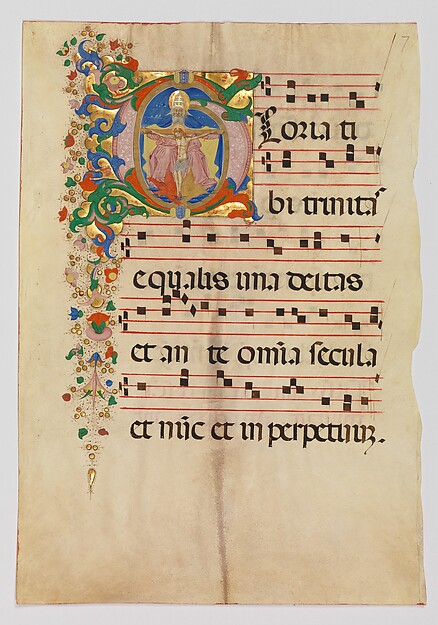
The Master of the Riccardiana Lactantius is an anonymous Florentine illuminator active in the second half of the fifteenth century, named for his distinctive decoration of folios in Biblioteca Riccardiana MS 544, a manuscript containing works by the early Christian author Lactantius. Little is known of his early life or training, which remains sparsely documented, though like many illuminators of the era, he likely honed his craft in bustling Florentine workshops amid the humanist revival spurred by patrons like the Medici family. His oeuvre exemplifies the late Gothic-to-Renaissance transition in Tuscan miniature painting, characterized by charming narrative scenes, soft pastel palettes, profuse floral and leaf motifs, and intricate white-vine-stem borders curling around gold bars on grounds of blue, green, and pink dotted with gold balls.
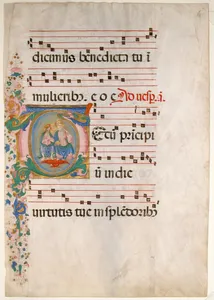
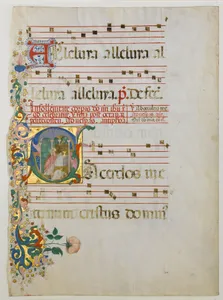
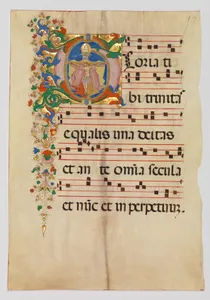
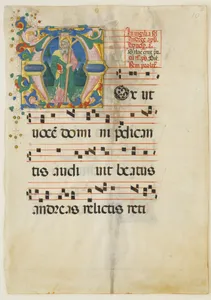
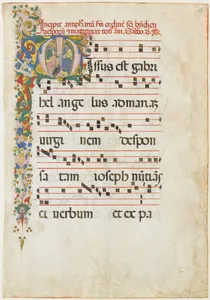
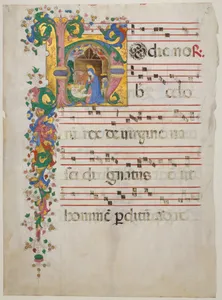
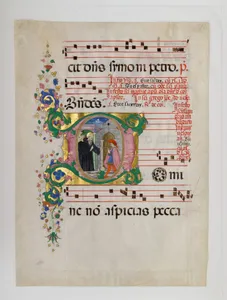
The master's style shines in historiated initials from a grand Benedictine antiphonary, a liturgical choir book now dismembered, with seven surviving leaves in the Metropolitan Museum of Art. These depict vivid scenes such as the Nativity within an Initial H, where angels proclaim Christ's birth amid pastoral charm (though their scrolls bear a scribe's whimsical misspelling: "Groria" instead of "Gloria"); the Trinity in Initials T or G; a celebratory Mass in Initial S; the Feast of Saint Andrew in Initial M; Saints John the Evangelist and Baptist in another M; and Saint Benedict resuscitating a boy at the monastery gate in Initial D. Other attributions include the opulent borders and poorly colored yet finely drawn animals in Marston MS 38 (Yale Beinecke Library), a ca. 1450–1460 translation of Diogenes Laertius's philosophers' lives, and a Book of Hours leaf with the Annunciation, Nativity, and prophets at the Cleveland Museum of Art.
Previously linked to Francesco d'Antonio del Cherico, these works were reattributed to the Riccardiana Master, highlighting his distinct hand in Florentine illumination. He may even have led a workshop influencing figures like Mariano del Buono. Though his identity eludes us, the Master's legacy endures in these luminous fragments, offering a window into Florence's vibrant manuscript culture, where piety met artistic invention on vellum pages destined for monastic choirs and scholarly shelves. His blend of narrative warmth and decorative finesse bridges medieval traditions with Renaissance humanism, enriching our understanding of anonymous talents who illuminated the era's spiritual life.
Wikidata (CC0)