
Ctrl K
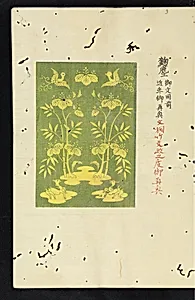
**Matsuoka Shiben (1764–1840)**, also known as Matsuoka Tokikata (松岡辰方), was a Japanese artist active during the late Edo period, renowned for his meticulous illustrations of textile patterns used in court attire. Specializing in shokumon zue—pattern books that documented intricate brocade designs—Shiben captured the opulent fabrics worn by imperial family members, courtiers, and samurai with extraordinary precision. His works, produced through woodblock printing in ink and color on paper, served as practical references for dyers, weavers, and designers, blending artistic finesse with technical utility.
Early life and training for Matsuoka Shiben are not well documented, though he emerged as a key figure in Edo-period textile documentation by the early 19th century. His signature style emphasized vibrant motifs of birds, plants, and geometric forms in bold hues like green, orange, and red, often depicting garments from multiple angles to showcase front and back patterns. Shiben's most celebrated work, *Patterns of Brocades Worn at Court (Shōzoku shokumon zue, 装束織文図会)*, dates to 1815 and forms part of a seven-volume series published between 1815 and 1825. This compendium, now held in institutions like The Metropolitan Museum of Art, illustrates ceremonial robes with lavish brocades reserved for elite circles.
Shiben collaborated closely with Honma Hyakuri (d. 1854), who augmented and completed volumes of *Shokumon zue*, with publishers such as Yawata Yoichi and later Yoshikawa Hanshichi issuing editions into the Meiji era. Additional works include *Shokumon zue (Nyokan)* at the Art Institute of Chicago and *Kanbō zue (冠帽図会)*, co-illustrated with Matsuoka Yukiyoshi, possibly a relative, focusing on headwear patterns. These publications worked in the tradition of Edo reference books, bridging art and craft.
Shiben's legacy endures through his role as a visual archivist of vanishing courtly splendor amid Japan's transition to modernity. His rare books, preserved in global collections, offer irreplaceable insights into hierarchical fashion, dyeing techniques, and aesthetic hierarchies of the time, influencing studies of Japanese textiles today. Though not a household name like ukiyo-e masters, Shiben's precise renderings remain essential for understanding Edo material culture.
All 1 artworks loaded