
Ctrl K
1873–1955
Maurice de Lambert, born Maurice Walter Edmond Labatt de Lambert on February 9, 1873, in Paris, was a French illustrator, painter, decorator, and engraver whose career spanned the Belle Époque and beyond. From a young age he showed exceptional talent for drawing. He studied under the Symbolist painter Gustave Moreau and the academic artist Georges-Antoine Rochegrosse, while also receiving advice from Albert Besnard and the master printmaker Félix Bracquemond. This training rooted him in the Academic tradition, emphasizing refined draftsmanship, decorative elegance, and a blend of Symbolist atmosphere with precise observation.
Lambert first gained recognition through book illustration. He created illuminations for Victor Hugo’s *La Légende du Beau* and Théophile Gautier’s *Le Chevalier double*, then produced notable illustrations for Guy de Maupassant’s *L’Inutile Beauté* (1904). He designed sets and shadow effects for Montmartre theater productions and executed full-length portraits of leading actors including Sarah Bernhardt, Sacha Guitry, and Réjane for the magazine *Le Théâtre*. His decorative interests extended to typography, where he designed vignettes for Grasset typefaces, and to posters such as the 1905 design for Émile Fabre’s play *Les Ventres dorés*.
His paintings and watercolors—often figure studies, genre scenes, and landscapes—were exhibited regularly in Paris and internationally in Brussels, New York, and Madrid. Later works include the 1935 watercolor *The Waterfall of the Parc de Sceaux*. He also contributed to the magazine *Paris sex-appeal*. Throughout, his style remained academic yet infused with the ornamental grace of Art Nouveau, particularly in his graphic work.
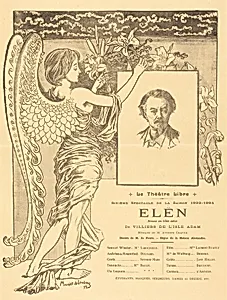
Though less celebrated today than some contemporaries, Lambert’s illustrations of major French authors and his contributions to theater and the decorative arts preserve a vivid record of late-nineteenth- and early-twentieth-century French cultural life. Examples of his work appear in collections such as the McNay Art Museum, which holds a 1895 program he designed for Le Théâtre Libre. He died on November 20, 1953, in Neuilly-sur-Seine. His elegant, historically evocative images continue to appeal to collectors and scholars of illustration and Belle Époque design.