
Ctrl K
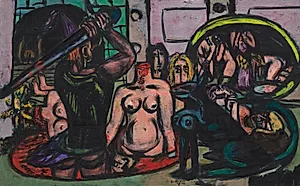
1884–1950
Max Carl Friedrich Beckmann (1884-1950) stands as one of the most significant German painters of the twentieth century, a complex artist who bridged Expressionism and the New Objectivity while forging a deeply personal visual language. Born in Leipzig into a middle-class family, Beckmann's artistic journey spanned from academic classicism through the traumatic crucible of World War I to a mature style characterized by compressed, angular compositions and profound allegorical content. Though often associated with German Expressionism, Beckmann rejected the label, preferring to chart his own course through the turbulent landscape of modern art. Beckmann's career trajectory mirrored the dramatic upheavals of twentieth-century European history. After early success in the Berlin art world, where he was elected to the executive board of the prestigious Berlin Secession by age twenty-six, his service as a medical orderly during World War I precipitated a complete artistic transformation. The horrors he witnessed on the battlefield—mangled bodies, endless casualties, the machinery of industrialized death—shattered his romantic worldview and led to a nervous breakdown in 1915. This trauma fundamentally altered his artistic vision, replacing his earlier painterly, impressionistic style with harsh angularity, compressed space, and dark, haunting imagery that confronted the brutality of modern existence. The apex of Beckmann's German career came during the Weimar Republic, when he achieved extraordinary professional success. Appointed to lead a master class at Frankfurt's prestigious Städelschule Academy in 1925, he received numerous honors including the Honorary Empire Prize for German Art and major retrospectives across Germany. Yet this success was violently interrupted by the Nazi rise to power. Branded a "degenerate artist," Beckmann was dismissed from his professorship in 1933, and over 500 of his works were confiscated from German museums. On the day after Hitler's infamous speech condemning modern art in 1937, Beckmann fled to Amsterdam, beginning a decade of exile that paradoxically proved one of his most productive periods. His monumental triptychs—including the seminal "Departure" (1932-1935)—emerged during these years as vehicles for profound meditations on human suffering, freedom, and transcendence. After ten years in occupied Amsterdam, Beckmann finally emigrated to America in 1947, teaching at Washington University in St. Louis and the Brooklyn Museum before his sudden death from a heart attack in New York in 1950, struck down while walking to see his own self-portrait on display at the Metropolitan Museum of Art.
Max Beckmann was born on February 12, 1884, in Leipzig, Saxony, as the youngest of three children in a middle-class grain merchant's family. His comfortable childhood was disrupted when his father died when Max was only ten years old, a loss that would resonate throughout his later work's preoccupation with mortality and human vulnerability. Despite the family tragedy, Beckmann received a thorough education, spending several years at boarding school while his artistic talents emerged early—by age fourteen, he was painting seriously and had determined his future career path.
In 1900, at sixteen, Beckmann enrolled at the Grossherzoglich-Sächsische Kunstschule Weimar (Weimar Saxon-Grand Ducal Art Academy) after initially failing the entrance examination for the more prestigious Königliche Akademie in Dresden. At Weimar's conservative academy, he underwent rigorous classical training, learning to draw from antique statues before progressing to human models. He studied primarily under Carl Frithjof Smith, a Norwegian realist painter who instilled a commitment to authentic representation, and was influenced by the idealistic classicism of Hans von Marées. The academy granted him a diploma with honors in 1902, recognizing his exceptional talent. It was also during these formative years that he met fellow art student Minna Tube, whom he would marry in 1906. Upon leaving Weimar in 1903, Beckmann embarked on the first of many trips to Paris, where he encountered the work of the Impressionists and discovered the revolutionary approaches of Cézanne and Van Gogh, experiences that would gradually erode his academic foundations.
In 1904, Beckmann relocated to Berlin, Germany's vibrant cultural capital, where he adopted the lush brushwork and dramatic technique of German Impressionist Lovis Corinth. His work during this period demonstrated considerable ambition and technical facility, combining academic training with contemporary influences. In 1905, Beckmann garnered national attention when his painting "Young Men by the Sea" won a prize at the annual exhibition of the German Artists' League (Deutscher Künstlerbund) in Weimar, earning him a six-month residency at the prestigious Villa Romana in Florence. Critics enthusiastically compared his style to Eugène Delacroix, dubbing the young artist the "German Delacroix." This early success established Beckmann as a promising talent among Germany's avant-garde circles.
The year 1906 proved pivotal when Beckmann joined the prestigious Berlin Secession and met the Norwegian Expressionist painter Edvard Munch, whose morbid, curvilinear compositions exerted a powerful influence on Beckmann's developing style. He married Minna Tube the same year, and the couple had a son. Beckmann's star continued to rise throughout the pre-war years; by 1910, he had been elected to the executive board of the Berlin Secession, the youngest member ever to achieve such distinction, reflecting his integration into Germany's most important avant-garde organization. His paintings from this period show a theatrical Post-Impressionist style combining dramatic compositions with confident brushwork. Despite his involvement with progressive artistic circles, Beckmann maintained elements of naturalistic representation, never fully embracing the radical abstraction or pure emotionalism of the Expressionist movement, foreshadowing his later rejection of that label.
The outbreak of World War I in August 1914 marked a catastrophic turning point in Beckmann's life and art. In the fall of 1914, filled with patriotic fervor and romantic notions of war, Beckmann volunteered for the German army medical corps, serving as a trained medical orderly rather than in combat roles. Initially deployed to East Prussia following the Battle of Tannenberg, he assisted in treating wounded soldiers amid the chaos of the Eastern Front. Later transferred to Belgian Flanders near the Western Front, Beckmann encountered the gruesome realities of industrialized warfare—mangled bodies, the ceaseless influx of casualties flooding field hospitals, the screams of the dying. His correspondence from this period describes the "brutality and cruelty" of the conflict, documenting how the unrelenting exposure to human suffering eroded his prior romantic worldview. The horror of what he witnessed proved psychologically unbearable.
In July 1915, while stationed in Belgium, Beckmann suffered a severe nervous breakdown characterized by acute psychological distress—what would later be termed shell shock or combat stress reaction. The breakdown incapacitated him from further duty and required institutionalization. He was discharged from military service in 1915 and moved to Frankfurt to recover, though the psychological wounds would never fully heal. This trauma precipitated a complete artistic transformation. The painterly, romantic compositions of his pre-war years were abandoned, replaced by a radically new visual language characterized by harsh angularity, extreme distortion, compressed claustrophobic space, and a darker, more subdued palette. Through his post-war art, Beckmann sought to process and express what he called the "injuries of the soul" he had suffered during his service. His harrowing 1918-1919 painting "The Night" (Die Nacht) exemplified this new approach, depicting contorted bodies and anguished faces of victims being tortured by sadistic intruders in a cramped, nightmarish interior. Filled with prophecy about the violence soon to engulf Germany, the painting established Beckmann as a voice of moral witness to his era's darkness.
During the Weimar Republic (1919-1933), Beckmann achieved extraordinary professional success while developing his mature artistic vision. With "The Night," he transcended Expressionism's bounds to become a leading figure in Neue Sachlichkeit (New Objectivity), a movement that emerged in Germany during the early 1920s as a reaction to post-war trauma and Expressionism's failure to transform society. The New Objectivity emphasized detailed, clear representation combined with social commentary and critical observation, though Beckmann characterized his own approach as "transcendental objectivity," quickly distancing himself from group labels. The movement's hard-edged portraiture and cynical attitude toward society resonated with Beckmann's war-shattered worldview. His numerous self-portraits from this period—including the iconic "Self-Portrait in Tuxedo" (1927)—presented himself alternately as successful businessman, defiant artist, and melancholic clown, revealing the masks and roles required to navigate modern existence.
In 1925, Beckmann was appointed to lead a master class in painting at the Städelschule Academy of Fine Art in Frankfurt, a prestigious position that solidified his influence in the German art world. He divorced Minna Tube that same year and married Mathilde von Kaulbach ("Quappi"), a young opera soprano who would remain his devoted companion through exile and emigration. His Frankfurt years (1925-1933) represented the apex of his German career: by 1929 he had been appointed to a full professorship, and his works were presented in eighteen solo and group exhibitions. Honors accumulated rapidly—in 1927 he received the Honorary Empire Prize for German Art and the Gold Medal of the City of Düsseldorf; in 1928 the city of Frankfurt awarded him its Grand Prize of Honour. A major retrospective at the Kunsthalle Mannheim in 1928, followed by exhibitions in Basel and Zurich in 1930, demonstrated the high esteem in which he was held. During these years, Beckmann began developing his monumental triptych format, adopting the traditionally religious three-panel structure to create complex allegorical narratives about modern existence. In 1932, he began work on "Departure," the first of nine triptychs that would occupy him for the rest of his life.
Beckmann's success ended abruptly with the Nazi rise to power in January 1933. The new regime immediately targeted modern art and its practitioners as part of their cultural purification campaign. Branded a "cultural Bolshevik" and "degenerate artist," Beckmann was dismissed from his professorship at the Städelschule in Frankfurt that same year. Over the following years, the persecution intensified: approximately 500-600 of his works were confiscated from German museums across the country, many vanishing forever. In 1937, several of his paintings—including the celebrated "Self-Portrait in Tuxedo"—were displayed in the notorious Entartete Kunst (Degenerate Art) exhibition in Munich, designed to ridicule and condemn modern art. Beckmann chose the symbolically charged date of July 19, 1937—the very day Hitler delivered his programmatic speech about German art at the opening of the Great German Art Exhibition in Munich, one day after the Degenerate Art exhibition opened—to flee Germany with Quappi for Amsterdam.
For ten years, Beckmann lived in self-imposed exile in Amsterdam, failing repeatedly in desperate attempts to obtain a visa for the United States. Despite the privation, isolation, and anxiety—conditions that worsened dramatically after Nazi Germany occupied the Netherlands in 1940—this period proved extraordinarily productive. Beckmann witnessed the deportation of Dutch Jews to Auschwitz and the imposition of the yellow star, events that infused his work with even greater urgency. In 1944, at age sixty, he narrowly avoided being drafted into the German army despite having suffered a heart attack. During these harrowing years, Beckmann completed several major triptychs including "Blindman's Buff" (1945), "The Actors" (1942), and "Carnival" (1943), along with numerous self-portraits and complex group compositions like "Les Artistes mit Gemüse" (Artists with Vegetables, 1943). These works combined mythological and Christian imagery with contemporary suffering, creating layered allegories about human endurance, the artist's role in dark times, and the possibility of transcendence. "Departure" (finally completed in 1935) remained his most powerful statement: its central panel depicting a royal family sailing toward freedom while the side panels showed scenes of torture and violence, expressing both the horror of the Nazi era and the indestructible human spirit.
In 1947, after ten years in Amsterdam, Beckmann finally received a visa to emigrate to the United States, arriving with Quappi to begin a new chapter at age sixty-three. He came to St. Louis at the invitation of Perry T. Rathbone, director of the Saint Louis Art Museum, who arranged for Washington University in St. Louis to hire Beckmann to teach at the School of Fine Arts, filling a vacancy left by Philip Guston. On September 18, 1947, Beckmann wrote hopefully in his journal: "It is possible that here it may be possible to live again." The couple adapted to American life, and Beckmann embraced the change of scenery and opportunity to start anew after years of harrowing exile. His time in St. Louis proved fruitful—he found an important patron and student in Morton D. May, a local collector who would later donate his substantial collection of Beckmann's works to the Saint Louis Art Museum, helping establish what is now the world's largest public collection of Beckmann's paintings and prints. The first Beckmann retrospective in the United States took place at the City Art Museum, Saint Louis, in 1948.
In 1949, Beckmann obtained an additional professorship at the Brooklyn Museum Art School in New York, dividing his time between teaching positions. He continued working intensely on his final triptych, initially titled "The Artists" but renamed "The Argonauts" following a dream just days before his death—a clear reference to the Greek mythological heroes who sought the Golden Fleece, suggesting Beckmann's view of the artist's quest for transcendental knowledge. In 1950, Beckmann visited St. Louis from his New York apartment to receive an honorary doctorate from Washington University. On December 26, 1950, he completed "The Argonauts," his ninth and final triptych, an affirmation of his belief in the indestructible human spirit. The following day, December 27, 1950, Max Beckmann died suddenly of a heart attack at the corner of 69th Street and Central Park West in New York City, struck down while walking to the Metropolitan Museum of Art to see his "Self-Portrait in Blue Jacket" (1950) on display. He was sixty-six years old. The tragic irony of dying en route to view his own work perfectly encapsulated Beckmann's lifelong dedication to his art, sustained through war, trauma, persecution, and exile until the very end.
Biography length: ~2,847 words
![Mann mit Spitzbart (Man with a Pointed Beard) [p. 66]](https://images.artheonmuseum.org/nga/thumb/mann-mit-spitzbart-man-with-a-pointed-beard-p-66-nga-64966.webp)
![Profil eines Mannes mit Spitzbart (Portrait of a Man with a Pointed Beard) [p. 64]](https://images.artheonmuseum.org/nga/thumb/profil-eines-mannes-mit-spitzbart-portrait-of-a-nga-64965.webp)
![Mann mit erhobenem Arm (Man with a Raised Hand) [p. 68]](https://images.artheonmuseum.org/nga/thumb/mann-mit-erhobenem-arm-man-with-a-raised-hand-p-68-nga-64967.webp)
![Dünenlandschaft, Farbangaben (Sketch with Notations) [p. 7]](https://images.artheonmuseum.org/nga/thumb/dnenlandschaft-farbangaben-sketch-with-notations-nga-64956.webp)
![Zuschauer (Audience) [p. 58]](https://images.artheonmuseum.org/nga/thumb/zuschauer-audience-p-58-nga-64962.webp)
![Männliche Bildnisstudie (Male Portrait Study) [p. 60]](https://images.artheonmuseum.org/nga/thumb/mnnliche-bildnisstudie-male-portrait-study-p-60-nga-64963.webp)
![Mann mit Brille (Man Wearing Spectacles) [p. 33]](https://images.artheonmuseum.org/nga/thumb/mann-mit-brille-man-wearing-spectacles-p-33-nga-64957.webp)
![Begonnenes Gesicht (Initial Sketch of a Face) [p. 37]](https://images.artheonmuseum.org/nga/thumb/begonnenes-gesicht-initial-sketch-of-a-face-p-37-nga-64959.webp)
![Zuschauer (Male Spectators) [p. 51]](https://images.artheonmuseum.org/nga/thumb/zuschauer-male-spectators-p-51-nga-64960.webp)
![Drei Studienköpfe (Study of Three Heads) p. 35]](https://images.artheonmuseum.org/nga/thumb/drei-studienkpfe-study-of-three-heads-p-35-nga-64958.webp)
![Mann im verlorenen Profil (Man Turned Away) [p. 62]](https://images.artheonmuseum.org/nga/thumb/mann-im-verlorenen-profil-man-turned-away-p-62-nga-64964.webp)
![Lächelnder Mann mit Spitzbart (Man with Pointed Beard, Smiling) [p. 70]](https://images.artheonmuseum.org/nga/thumb/lchelnder-mann-mit-spitzbart-man-with-pointed-nga-64968.webp)
![Meereslandschaft, Farbangaben (Seascape with Notations) [p. 100]](https://images.artheonmuseum.org/nga/thumb/meereslandschaft-farbangaben-seascape-with-nga-64969.webp)