Ctrl K
1898–1972
Maurits Cornelis Escher (1898-1972) was a Dutch graphic artist renowned for his mathematically-inspired woodcuts, lithographs, and mezzotints featuring impossible constructions, tessellations, and explorations of infinity. Though he considered himself lacking in mathematical ability, Escher's work demonstrates profound intuitive understanding of geometry, symmetry, and spatial paradox. A transformative visit to the Alhambra in 1922 sparked his lifelong fascination with tessellations, while later collaborations with mathematicians like Roger Penrose inspired his famous impossible structures. Creating 448 prints and over 2,000 drawings during his lifetime, Escher remained largely overlooked by the art establishment until late in life, yet became one of the most popular and influential graphic artists of the 20th century.
Born June 17, 1898, in Leeuwarden, Netherlands, Escher showed early artistic talent but struggled academically. From 1919 to 1922, he studied at the Haarlem School of Architecture and Decorative Arts, initially pursuing architecture before switching to graphic arts under Samuel Jessurun de Mesquita.
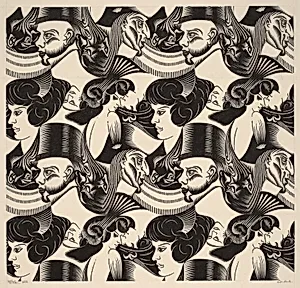
His first trip to Spain in 1922 proved transformative. At the Alhambra palace in Granada, the intricate Moorish tile patterns—geometric tessellations covering walls and ceilings—sparked a fascination with mathematical symmetry that would define his career.
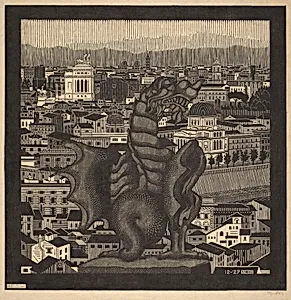
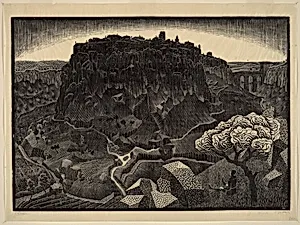
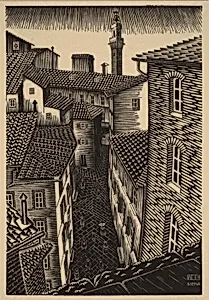
Escher settled in Italy in 1923, living in Rome from 1924 to 1935. He married Jetta Umiker in 1924 and traveled extensively throughout southern Italy, creating detailed lithographs and woodcuts of Mediterranean landscapes, architecture, and villages perched on cliffsides.
These Italian works demonstrated his mastery of perspective and his attraction to unusual viewpoints—looking up from below, down from above, or through reflective surfaces. The surreal quality of Italian hill towns influenced his later impossible architectures.
Political tensions forced Escher to leave Italy in 1935. After brief stays in Switzerland and Belgium, he settled in the Netherlands in 1941. A second visit to the Alhambra in 1936 intensified his study of tessellations, leading to systematic explorations of interlocking shapes.
His 'Metamorphosis' series (1937-1939) demonstrated his unique ability to transform one tessellated pattern into another across extended horizontal compositions. Works like 'Day and Night' (1938) and 'Sky and Water' (1938) showed birds becoming fish, geometric patterns becoming recognizable forms.
Escher's collaboration with mathematician Roger Penrose in the 1950s inspired his most famous impossible constructions. 'Relativity' (1953), 'Ascending and Descending' (1960), and 'Waterfall' (1961) depict architectural impossibilities that seem logical at first glance but violate physical reality.
Though ignored by the art establishment, Escher gained devoted following among mathematicians, scientists, and the counterculture. He was knighted in 1955 and received his first major retrospective at age 70. He died March 27, 1972, in Hilversum, leaving behind 448 prints and over 2,000 drawings.
Biography length: ~880 words