Ctrl K
1051–1107
Mi Fu (1051–1107), a towering figure of the Northern Song dynasty, was born in Taiyuan into a family with court connections; his mother served as wet nurse to Emperor Yingzong, allowing him to grow up amid the imperial precincts, mingling freely with the royal family. Precociously talented, he displayed early aptitude in calligraphy, poetry, and painting, though he expressed distaste for rigid formal lessons intended for future officials. Instead, Mi Fu honed his skills through patient study of ancient masters, particularly drawing calligraphic influence from Wang Xizhi, eschewing flamboyant novelty for styles blending historical reverence with personal spontaneity and self-expression. His official career was checkered—rising no higher than second-class secretary due to his individualistic temperament—yet he amassed renowned collections of paintings, stones, and inkstones, dividing them into secret and displayed caches.
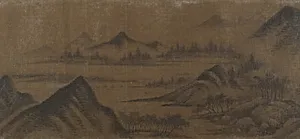
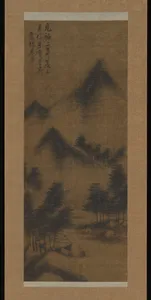
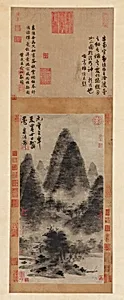
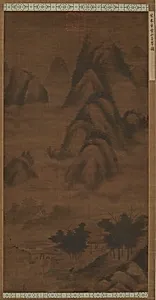
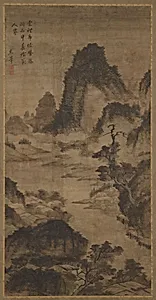
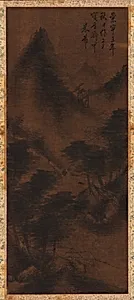
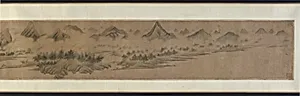
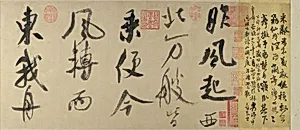
A dominant innovator in literati painting, Mi Fu worked in the Southern School tradition, pioneered by Wang Wei and Dong Yuan, revolutionizing landscapes with his "splashed ink" (pomo) technique. Using broad, wet ink dots—later dubbed "Mi dots"—applied with a flat brush, he evoked misty rivers, cloud-shrouded hills, and rainy Henan lake districts, shifting from precise lines to atmospheric washes that captured nature's ephemeral essence. In calligraphy, one of Song China's four great masters alongside Su Shi, Huang Tingjian, and Cai Xiang, his running and grass scripts resembled "a collection of ancient characters," dynamic and sword-like in vigor, as praised by Su Shi. This bold aesthetic extended to poetry, echoing Li Bai's verve, and informed his theoretical writings.
Key surviving works include the calligraphy scrolls *Shu Su Tie* (also *Nigu Shitie*), *Zhang Jiming Tie*, *Li Taishi Tie*, *Zijin Yan Tie*, and *Danmo Qiushan Shitie*, alongside paintings like *Tower of the Rising Clouds* (Freer Gallery of Art) and *Auspicious Pines in Spring Mountains*. His eldest son, Mi Youren, inherited and perpetuated the Mi style, presenting works to the court on his father's behalf.
Mi Fu's legacy endures through treatises like *Huashi* ("History of Painting"), offering invaluable Song-era insights on connoisseurship, preservation, and aesthetics, and *Haiyue Mingyan*, extolling creative vitality. Renowned for eccentricities—worshipping bizarre rocks, donning ancient garb, and obsessive cleanliness—his "splashed ink" profoundly shaped subsequent Chinese painting, inspiring generations to prioritize expressive mood over literalism.