Ctrl K
1725–1775
Mir Kalan Khan (c. 1725–1775) was an esteemed Indian painter active in the 18th century, bridging the grandeur of Mughal miniature traditions with the refined provincial styles of the Awadh court in Lucknow. Working primarily during the mid-1700s under the patronage of Nawabs in the Oudh region—a successor state to the Mughal Empire—Khan exemplified the evolution of Indian painting as imperial workshops decentralized. His oeuvre, preserved in prestigious collections like the Metropolitan Museum of Art and documented on platforms such as Artnet, reflects a mastery of opaque watercolor and gold on paper, capturing both spiritual assemblies and intimate secular scenes with delicate naturalism.
Little is known of Mir Kalan Khan's early life or formal training, as biographical details remain sparsely documented in historical records. However, his stylistic affinities suggest exposure to Mughal atelier techniques, evident in his adaptations of earlier imperial compositions. Khan operated within the Lucknow school, a vibrant post-Mughal tradition characterized by luminous colors, intricate detailing, and themes blending mysticism, daily life, and courtly elegance. This regional style, flourishing in Awadh from the 1750s onward, incorporated Persian influences while embracing local Hindu and Sufi motifs, diverging from the stricter realism of Jahangir-era Mughal art.
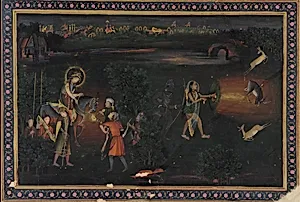
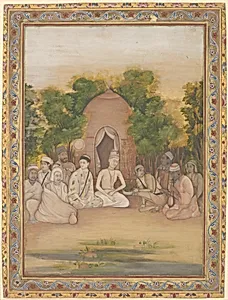
Among his notable works is *A Gathering of Holy Men of Different Faiths* (Metropolitan Museum of Art), a reinterpretation of a circa 1655 Mughal prototype featuring revered figures like Kabir, Ravidas, and Namdev in a harmonious interfaith convocation. Another standout is *Ladies Visiting an Ascetic* (c. 1750), a moonlit nocturnal scene depicting Hindu women offering food to a sage, showcased in auctions and admired for its jewel-like precision and emotional subtlety. A gouache depiction of *Village Life in Kashmir* (c. 1760), in Lucknow style, further highlights his versatility, portraying vernacular architecture and attire with ethnographic fidelity.
Mir Kalan Khan's legacy endures as a pivotal figure in the diffusion of Mughal aesthetics into provincial courts, influencing later Awadh and Company School painters. His works, now rare treasures in global museums, offer invaluable glimpses into 18th-century India's cultural syncretism, reminding us how artists like him sustained miniature painting's poetic vitality amid political flux. Though his personal story fades, his canvases illuminate an era of artistic resilience. (Word count: 378)