Ctrl K
1636–1699
Occupations
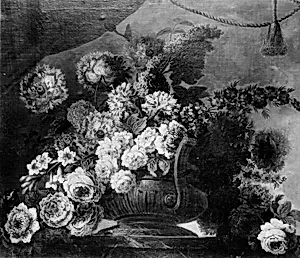
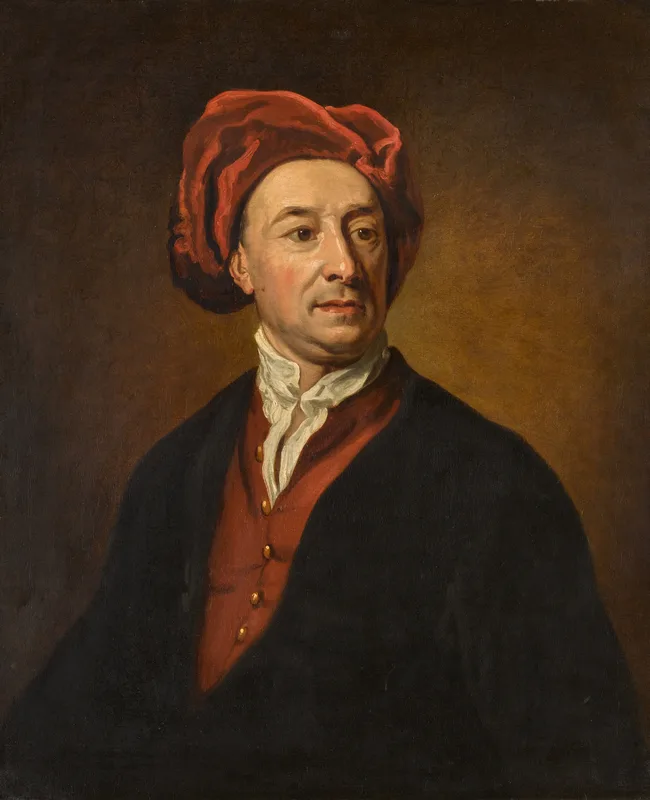
Jean-Baptiste Monnoyer (1636-1699) was a Franco-Flemish painter who became the most distinguished and formative still life and flower painter of the French Baroque period. Born in Lille, he trained in Antwerp where he absorbed the techniques of Flemish masters before moving to Paris by 1650. Patronized by Charles Le Brun, Louis XIV's Minister of Arts, Monnoyer worked extensively on decorative paintings for royal palaces including Versailles, Marly, and Meudon. His magnificent floral compositions featured opulent arrangements in luxurious vases, characterized by brilliant colors and botanical accuracy. Monnoyer was instrumental in designing floral motifs and borders for the Gobelins and Beauvais tapestry manufactories, profoundly influencing French decorative arts. In 1665, he became a member of the Académie Royale de Peinture et de Sculpture. In 1690, at the height of his fame, he moved to England at the invitation of Ralph Montagu, where he created a sensation among the English aristocracy and received royal commissions from Queens Mary II and Anne. His influential suite of engravings, 'Le Livre de toutes sortes de fleurs d'après nature', served as essential pattern books for artisans and decorative designers for decades after his death in London in 1699.
Jean-Baptiste Monnoyer was born on January 12, 1636, in Lille, France, into a family of painters. Little is known about his early training, though he appears to have studied in the Flemish town of Antwerp, a major center for still life painting in the 17th century.
In Antwerp, Monnoyer encountered the works of Flemish masters including Jan Davidsz de Heem, Frans Fyt, and Hieronymus Galle. These artists specialized in grand floral still lifes that contrasted with the more scientific botanical illustrations of contemporaries like Nicolas Robert. Monnoyer absorbed the Flemish techniques of rich color coordination, clear drawing, and compositions featuring luxurious arrangements.
By 1650, Monnoyer had established himself in Paris, where he was documented working on the interior decorations of the prestigious Hôtel Lambert. Though originally trained in history painting, he soon discovered his true calling in still life painting, particularly focusing on flowers.
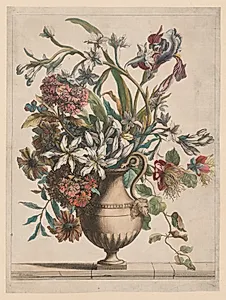
During this formative period, Monnoyer developed his signature style: magnificent bouquets overflowing from ornate urns and baskets, with flowers chosen for their particular shape and color to create harmonious, opulent compositions. His painting style showed clear influences from Flemish art, particularly Rubens, while adapting to French tastes.
In 1665, Monnoyer achieved official recognition when he was received into the prestigious Académie Royale de Peinture et de Sculpture with a still life of flowers and fruit combined with objets d'art. This marked his establishment as a leading specialist in the genre. He was later appointed Counsellor to the Académie in 1679.
Monnoyer's career flourished under the patronage of Charles Le Brun, Louis XIV's powerful Minister of Arts and court painter. He was employed to create decorative paintings for numerous royal residences, including the châteaux of Versailles, Marly, Meudon, Saint-Cloud, Vincennes, and the Tuileries Palace. At Vincennes, he painted garlands of flowers on the ceilings of the Queen's apartments under the supervision of Philippe de Champaigne.
His work for the Sun King was extensive and highly valued. Louis XIV owned approximately sixty of Monnoyer's paintings, testament to the royal appreciation of his art. At Versailles, Monnoyer collaborated with Le Brun on floral and still life decorations for the Grand Trianon and other royal apartments.
Simultaneously, Monnoyer was attached to the Gobelins tapestry workshops and the Beauvais tapestry manufactories, where he produced cartoons of fruits and flowers for tapestry borders and ornamental designs. Beginning in 1666 at Gobelins, he designed floral motifs that would define French decorative arts for generations.
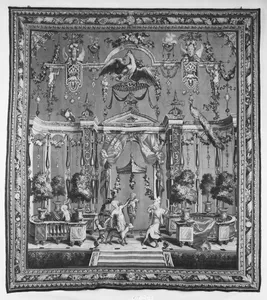
One of his most significant tapestry collaborations was the chinoiserie series 'The Story of the Emperor of China' (designed 1685-1690), created with Guy Vernansal and Jean-Baptiste Belin de Fontenay. This series was woven at the Beauvais Manufactory and included ten scenes such as 'Audience with the Emperor', 'The Emperor Sailing', and 'The Empress's Tea'.
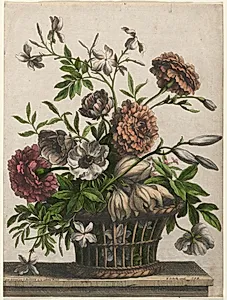
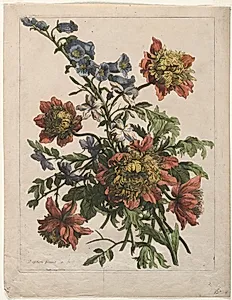
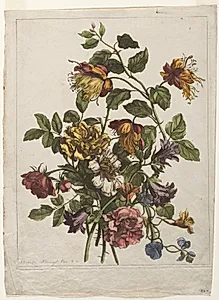
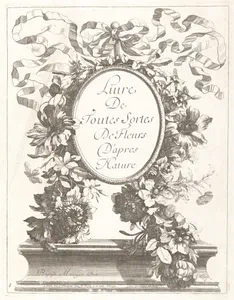
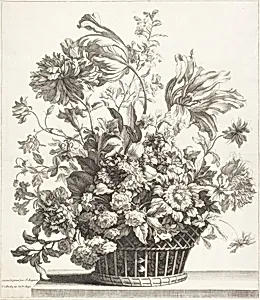
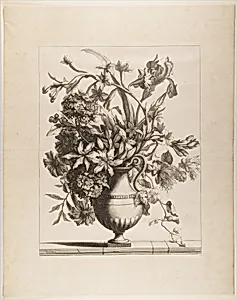
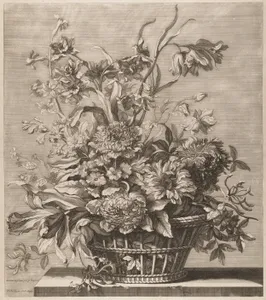
During this period, Monnoyer also published suites of engravings, most notably 'Le Livre de toutes sortes de fleurs d'après nature', which demonstrated flowers with botanical accuracy. These prints served as pattern books for artisans working in tapestries, carpets, embroidery, and other decorative arts, disseminating his style throughout France and Europe.
In 1690, at the age of 54 and at the height of his fame, Monnoyer made a momentous decision to leave France for England. He accepted an invitation from Ralph Montagu, the English ambassador to France, to work on decorative paintings for Montagu House in Bloomsbury, London.
For Montagu House, Monnoyer produced over fifty panels of fruit and flowers for overmantels and overdoors. Some of these magnificent panels have survived and are now preserved at Boughton House in Northamptonshire, demonstrating the scale and ambition of this commission.
Monnoyer's arrival in England created a sensation. His large-scale, opulent floral compositions, populated with huge urns or baskets overflowing with ornate flowers, proved immensely popular with the English aristocracy. He was soon inundated with commissions from noble families eager to have his decorative paintings adorn their great houses.
His success extended to the highest levels of English society. Queens Mary II and Anne both commissioned Monnoyer to paint still lifes for Kensington Palace, cementing his reputation as the premier flower painter in England.
Despite his advanced age, Monnoyer remained productive throughout the 1690s, continuing to create his characteristic floral masterpieces. His influence on English decorative painting was profound and lasting. After his death, his engravings of flower pieces continued to be used by tapestry makers, including those at the Soho tapestry works in London.
Jean-Baptiste Monnoyer died in London on February 20, 1699, at the age of 63. He left behind a remarkable artistic legacy that spanned both France and England, having helped define the aesthetic of floral still life painting for the Baroque era.
Artheon Research Team
Last updated: 2025-11-28
Biography length: ~1,150 words
Wikidata/Wikimedia Commons
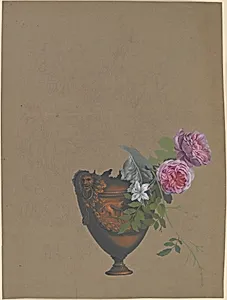
![[Small Bouquets Tied With A Ribbon]](https://images.artheonmuseum.org/met/dp/thumb/small-bouquets-tied-with-a-ribbon-354156.webp)
![[Flowers Arranged in a Glass Vase]](https://images.artheonmuseum.org/met/dp/thumb/flowers-arranged-in-a-glass-vase-380624.webp)
![[Small Bouquets]](https://images.artheonmuseum.org/met/dp/thumb/small-bouquets-354155.webp)
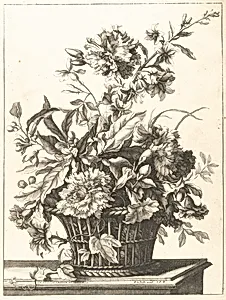
![[Flowers Arranged in a Glass Vase]](https://images.artheonmuseum.org/met/dp/thumb/flowers-arranged-in-a-glass-vase-354157.webp)