Ctrl K
1645–1667
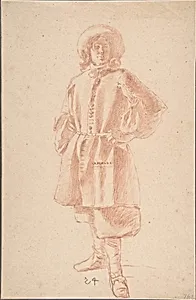
Moses ter Borch (1645–1667) was a Dutch Golden Age draftsman whose brief life and tragic death during military service have made him a poignant figure in Dutch art history. Born in Zwolle in 1645 as the youngest son of Gerard ter Borch the Elder, Moses grew up in one of the Netherlands' most accomplished artistic families. His half-siblings—Gerard ter Borch the Younger (1617–1681), the celebrated genre painter, Gesina ter Borch (1631–1690), and Harmen ter Borch (1638–before 1677)—were all gifted artists trained by their father. Moses's work consists mostly of drawings, demonstrating the family's emphasis on draughtsmanship as the foundation of artistic practice. His siblings taught him to draw and paint, providing instruction in the refined technique characteristic of the ter Borch family. Tragically, Moses died in 1667 at age twenty-two during the storming of Fort Languard near Felixstowe, England, during the Second Anglo-Dutch War. He was buried in Harwich as a result of wounds suffered in combat. Shortly after his death, his siblings Gerard and Gesina created a moving memorial portrait filled with symbolic objects alluding to Moses's heroic death and the transience of life.
Moses ter Borch was born in Zwolle in 1645, the youngest son of Gerard ter Borch the Elder (1583–1662), a painter and drawing master who trained all his children in art.
Moses was the half-brother of Gerard ter Borch the Younger (1617–1681), the most famous and prolific artist in the ter Borch family, renowned for his sophisticated genre scenes and portraits.
His other half-siblings, Gesina ter Borch (1631–1690) and Harmen ter Borch (1638–before 1677), were also gifted artists. Gesina and Gerard taught Moses to draw and paint, providing instruction in the family's refined technique.
Moses's work consists mostly of drawings, reflecting the ter Borch family's emphasis on draughtsmanship. Though his artistic output was limited by his youth and brief life, his training within this accomplished family provided him with a solid foundation.
The ter Borch family maintained a collaborative artistic practice, with family members often working together on projects and supporting each other's development—a tradition that would be honored in the memorial portrait created after Moses's death.
Moses ter Borch died young during military service in 1667. He was killed during the storming of Fort Languard (also called Fort Landguard) near Felixstowe in England, during the Second Anglo-Dutch War (1665–1667).
This naval conflict between the Dutch Republic and England was one of a series of Anglo-Dutch Wars fought during the seventeenth century for commercial and naval supremacy.
Moses died and was buried in Harwich as a result of wounds suffered during the assault on the fort. He was only twenty-two years old.
His death was a devastating loss for the ter Borch family, cutting short a promising artistic career and taking their youngest member.
Not long after Moses's death, his siblings Gerard ter Borch the Younger and Gesina ter Borch collaborated on a memorial portrait to honor their youngest brother.
Gerard painted Moses's portrait, while Gesina painted the background and the symbolic objects. This collaborative work demonstrates the family's artistic unity and their shared grief.
The portrait is filled with objects alluding to Moses's heroic death and the transience of life: a pocket watch (symbolizing time), a skull (representing death), ivy on rocks (suggesting eternity), and dogs (symbolizing loyalty).
This memorial portrait (now in the Rijksmuseum, Amsterdam) serves both as a commemoration of Moses and as a meditation on mortality, heroism, and familial love—a touching example of seventeenth-century memorial art.
Artheon Research Team
Last updated: 2025-11-09
Biography length: ~463 words