
Ctrl K
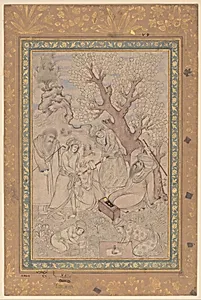
1575–1684
**Muhammad Qasim Tabrizi** (c. 1575–1659) was a leading Persian miniaturist of the Safavid era, renowned for his elegant single-figure studies and narrative illustrations that captured the refined courtly life of Isfahan. Born in Tabriz, he moved to the Safavid capital, where he became one of the most influential painters of the seventeenth century.)
Although long thought to have been a pupil of Reza Abbasi, recent scholarship has clarified that Qasim was a contemporary who developed a parallel yet distinctive approach within the same artistic milieu. His early works show the influence of masters such as Sadiq Bek, evident in delicate portrayals of youths and maidens rendered with fluid lines and subtle washes. By the middle period he had established himself as a court painter to Shah Abbas the Great, producing intimate portraits and genre scenes that blended poetic sensibility with precise observation.)
Qasim’s major works include the celebrated “Shah Abbas Embracing a Page” (1627, Louvre), a series of illustrations for a 1648 Shahnameh manuscript now in the Royal Collection at Windsor, and contributions to manuscripts such as Vahshi Bafqi’s *Farhad and Shirin* and Muhammad Riza’s *Suz u Gudaz*. He also painted wall decorations for the Chehel Sotoun palace in Isfahan. His late drawings, such as “Man Holding an Album” (c. 1650, British Museum), reveal a contemplative, almost spiritual quality.)
Today Qasim is recognized as one of the greatest and most influential artists of mid-seventeenth-century Isfahan, whose refined single-figure compositions and narrative miniatures helped define the Isfahan school of Persian painting. His works are preserved in major collections worldwide, including the Metropolitan Museum of Art, the British Museum, and the Victoria and Albert Museum, ensuring his legacy endures in the study of Safavid art.