
Ctrl K
1930–2012
Neil Armstrong, born on August 5, 1930, in Wapakoneta, Ohio, developed an early fascination with flight, constructing model aircraft and earning his student pilot certificate at age 16. He pursued aeronautical engineering at Purdue University, graduating with a B.S. in 1955, followed by a master's from the University of Southern California in 1970. Armstrong served as a naval aviator during the Korean War, flying 78 combat missions, before becoming a test pilot at NASA's predecessor, NACA, where he piloted over 200 types of aircraft, including the X-15 rocket plane. Selected for NASA's second astronaut group in 1962, his engineering precision and piloting expertise positioned him as commander of Apollo 11 in 1969, though no formal artistic training is documented.
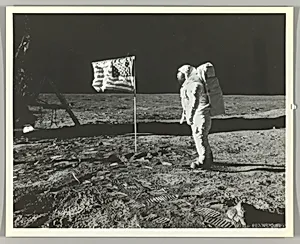
During Apollo 11, Armstrong piloted the lunar module Eagle to the Sea of Tranquility, becoming the first human on the Moon on July 20, 1969. Tasked with mission documentation despite lacking photographic training, he wielded a Hasselblad camera to capture fellow astronaut Buzz Aldrin's extravehicular activities, producing some of the earliest images from the lunar surface. Key works include *Buzz Aldrin with Apollo 11 Lunar Module on the Moon* (1969, chromogenic print), *Aldrin standing next to solar wind experiment* (1969), *Aldrin near the north footpad* (1969), and *Aldrin descends lunar module ladder* (1969), now held in collections at the Metropolitan Museum of Art, San Francisco Museum of Modern Art, and others. These stark, high-contrast images, framed against the barren lunar landscape and gleaming hardware, embody documentary precision in the NASA tradition.
Armstrong's photographs transcend mere records, entering fine art discourse as artifacts of human achievement, exhibited alongside paintings and prints in shows like the Met's *Apollo's Muse* (2019). His style—unadorned, technically masterful—reflects his engineering mindset, prioritizing clarity and evidential truth over aesthetic flourish. Post-Apollo, he taught at the University of Cincinnati until 1979, served on accident investigations, and lived privately until his death in Cincinnati on August 25, 2012.
Though his legacy centers on exploration, Armstrong's lunar imagery endures in museums, symbolizing humanity's giant leap. Acquired by institutions like SFMOMA (over 10 prints) and the National Gallery of Art, they affirm his inadvertent role in space photography's canon, bridging science and visual history.