
Ctrl K
1800–1900
**Nicholas Shiels: A Victorian Genre Painter of Soldiers and Scenes**
Nicholas Shiels was a British artist active in the late nineteenth century, particularly during the 1880s, when he exhibited works in Scotland before traveling to Australia. Little is known about his early life and artistic training, as biographical details remain scarce beyond his professional activities in Edinburgh and beyond. Operating during the Victorian era, Shiels captured the spirit of British military life and everyday landscapes with a realistic, narrative-driven style typical of genre painting, evoking the camaraderie and hardships of soldiers alongside quaint English vistas and Australian coastal motifs.
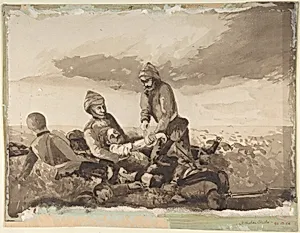
Among his notable works is *The Wounded Comrade* (1884–89), a poignant depiction of Victorian British soldiers aiding a fallen comrade, rendered with dramatic tension and empathetic detail that highlights the human cost of duty. This painting exemplifies his focus on military subjects, infused with emotional depth. Shiels also produced *Ride or Drive* (1888), a lively watercolour or gouache exploring equestrian themes, alongside *Mermaid Street, Rye, Sussex, England*, a charming watercolour of a picturesque English lane, and *Boat House*, an intimate oil on card study. His Australian sojourn inspired pieces like *Four Veterans at Cronulla*, an oil on board portraying aged soldiers by the beach, blending nostalgia with colonial observation.
Shiels's legacy endures through a modest corpus of works that surface in Australian art auctions, where they fetch prices reflecting their historical charm and rarity. Though not aligned with major movements or prominent academies, his output bridges British Victorian sensibilities with Antipodean experiences, offering glimpses into imperial lives. Today, his paintings serve as evocative windows into a bygone era, cherished by collectors for their unpretentious storytelling and technical finesse. With only a handful of documented pieces, Shiels remains an enigmatic figure whose contributions quietly enrich our understanding of late-nineteenth-century genre art.