
Ctrl K
**Paul Deferneville: Master of the Fashion Plate**
Paul Deferneville was a French engraver and illustrator active throughout the nineteenth century, renowned for his delicate and vibrant fashion plates that captured the elegance of Parisian style for popular periodicals. Little is known of his early life or formal training, as biographical details remain scarce in art historical records. His career flourished from at least the 1860s into the 1890s, during the height of the Second Empire and Belle Époque eras, when illustrated journals democratized high fashion for a wide audience.
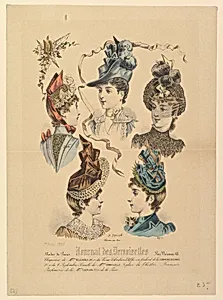
Deferneville's oeuvre centers on contributions to leading women's magazines such as *Journal des Demoiselles*, *Les Modes Parisiennes*, *Revue de la Mode*, and *Le Moniteur de la Mode*. Notable works include "Ladies' Hats, No. 4671" from *Journal des Demoiselles* (April 1, 1888), a steel engraving enhanced with hand coloring and gilt, depicting stylish headwear models; and "Five Hat Models" from the same publication (1888), a hand-colored lithograph. Other highlights feature "Les Modes Parisiennes, No. 1756" (1877), showcasing specialty costumes; No. 1749 (1878) advertising Parfumerie Oriza; and later plates like "Toilettes d'amazones, No. 4272" (1880), "Modes de Mme Boucheri, No. 4592 bis" (1886), and "Toilettes de Mme Galard, No. 4956" (1896).--0754062e9b64bb7771629d51c6ddcef7) These pieces often integrated advertisements for fabrics, perfumes, and tailors, blending artistry with commerce. Printers like Imprimerie Falconer in Paris frequently produced his designs, sometimes in collaboration with figures such as Jules David.
His style exemplifies the precision of nineteenth-century reproductive printmaking, employing steel engravings and lithography to render intricate details of gowns, accessories, and hairstyles with lifelike poise and subtle color washes. Deferneville's plates not only documented transient trends—from bustled walking dresses to elaborate hats—but also served as aspirational imagery for middle-class readers across Europe, as seen in English adaptations like those in *The Englishwoman's Domestic Magazine* (1867).
Though overshadowed by more famous contemporaries, Deferneville's prolific output endures in collections like the Metropolitan Museum of Art and Rijksmuseum, preserving a vivid chronicle of Victorian and Edwardian fashion evolution. His work underscores the vital role of print illustrators in shaping cultural perceptions of modernity and femininity.
All 1 artworks loaded